No products added!

Granulation is a jewelry-decoration technique that uses tiny metal spheres, often called granules, to create textured borders, patterns, and raised ornament on a metal surface. It is known for precise detail in historical goldsmithing and remains useful in contemporary jewelry design.
What Is Granulation in Jewelry Manufacturing?
The granules are separate, rounded pieces of metal that are attached to a base or arranged into a design. They may form lines, clusters, geometric motifs, or repeated textures, often alongside wirework or other decorative elements.
How Granulation Is Performed
A jeweler first forms granules of reasonably consistent size and positions them on a prepared metal surface. The granules are then joined through a carefully controlled heating process. Historical techniques can use diffusion or eutectic bonding with little visible solder; modern workshops may use other suitable joining approaches.
Where Granulation Is Used in Jewelry Production
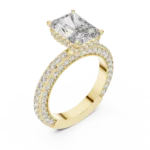
Granulation appears on rings, pendants, earrings, beads, and decorative panels. It can emphasize edges, frame gemstones, or add depth to otherwise flat metal surfaces. The technique is often combined with filigree or engraving for more complex designs.
Benefits and Limitations of Granulation
Granulation creates rich surface texture without relying on gemstone accents. It is labor-intensive, however, because the size, placement, and bonding of each granule affect the final result. Poorly joined granules may detach during wear or finishing.
Related Jewelry Manufacturing Terms
- Filigree: Fine wirework arranged into ornamental patterns.
- Soldering: A method of joining metal parts with a lower-melting filler alloy.
- Chasing: Shaping or refining a metal surface from the front using tools.
For further learning, explore the Custom Karat Jewelry Glossary and Advanced Manufacturing.

About Author Priyanka Kale
Priyanka Kale is a jewelry retail industry author who shares knowledge on diamonds, lab-grown jewelry, custom designs, and jewelry buying tips. Her content helps customers understand quality, pricing, trends, and craftsmanship before making confident jewelry purchase decisions.