No products added!


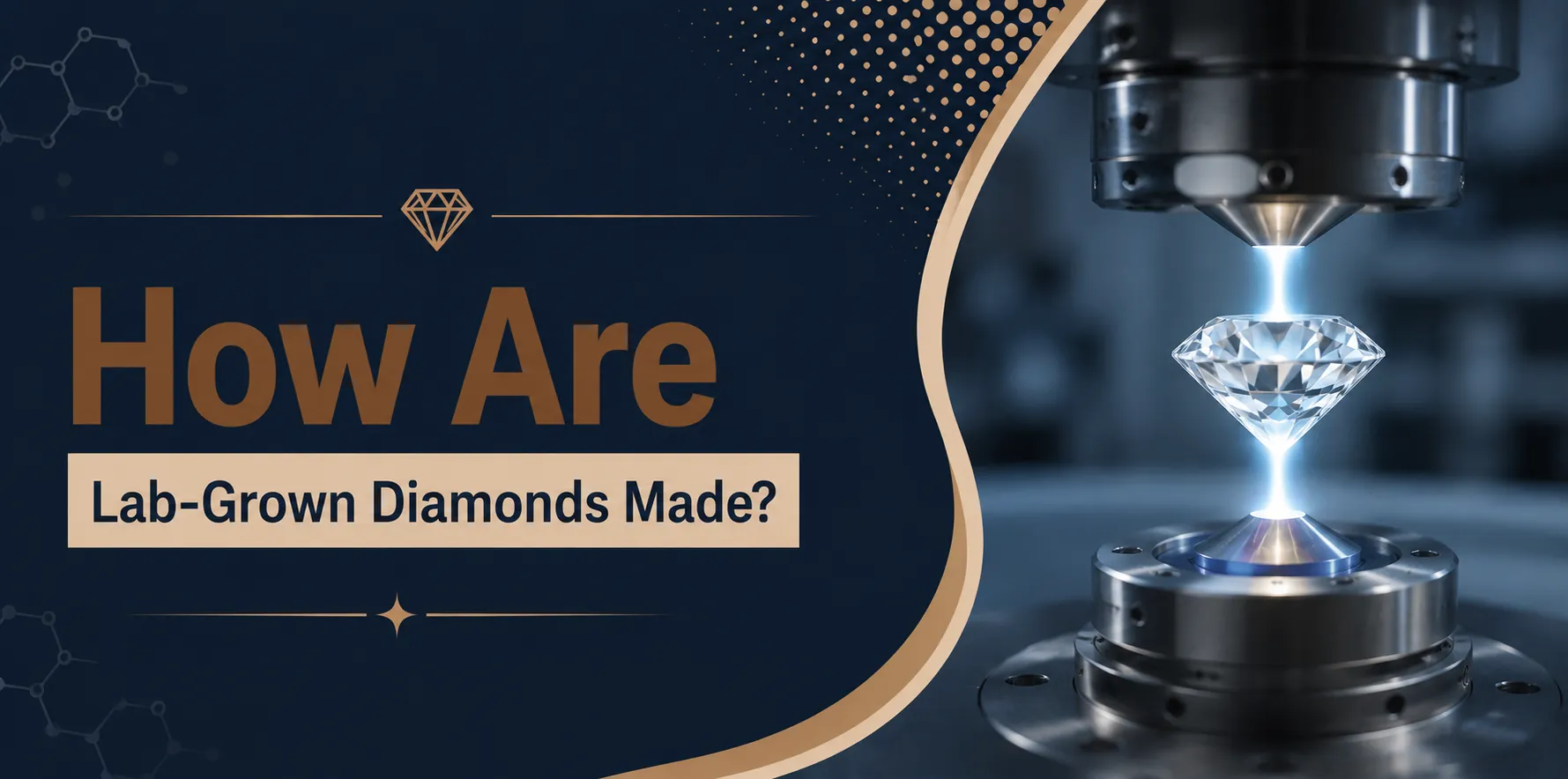
Lab-grown diamonds have transformed the jewelry industry by offering consumers a more affordable and sustainable alternative to mined diamonds. But one question remains common among buyers: How are lab-grown diamonds actually made?
The answer is fascinating. Scientists use advanced technology to recreate the exact conditions under which natural diamonds form deep beneath the Earth’s surface. The result is a diamond that is chemically, physically, and optically identical to a natural diamond.
In this guide, you’ll learn:
- How lab-grown diamonds are created
- The two primary manufacturing methods
- How long the process takes
- Whether lab-grown diamonds are real diamonds
- How they compare to natural diamonds
- What buyers should know before purchasing
Key Takeaways
- Lab-grown diamonds are real diamonds, not simulants.
- They are created using advanced technology that replicates natural diamond formation.
- Two main production methods are used:
- HPHT (High Pressure High Temperature)
- CVD (Chemical Vapor Deposition)
- Lab-grown diamonds possess the same chemical composition as natural diamonds.
- Most high-quality lab diamonds are certified by organizations such as IGI and GIA.
- Buyers can often save 30–70% compared to natural diamonds of similar specifications.
What Is a Lab-Grown Diamond?
A lab-grown diamond is a genuine diamond produced in a controlled laboratory environment rather than mined from the earth.
Just like natural diamonds, lab-grown diamonds are composed of pure carbon atoms arranged in a crystal structure.
Because they share the same molecular composition, even professional jewelers require specialized equipment to distinguish a lab-grown diamond from a mined diamond.
The Science Behind Diamond Formation
To understand lab-grown diamonds, it helps to understand how natural diamonds form.
Natural diamonds are created:
- Approximately 90–150 miles below the Earth’s surface
- Under extreme pressure
- At temperatures exceeding 2,000°F (1,100°C)
- Over billions of years
Scientists discovered ways to replicate these conditions in laboratories, dramatically reducing formation time from billions of years to a matter of weeks.
The Two Methods Used to Create Lab-Grown Diamonds
Today, nearly all lab-grown diamonds are produced using one of two techniques.
| Method | Full Form | Popularity | Quality |
| HPHT | High Pressure High Temperature | High | Excellent |
| CVD | Chemical Vapor Deposition | Very High | Excellent |
Let’s examine both methods in detail.
Method 1: HPHT (High Pressure High Temperature)
HPHT was the first successful method developed for growing diamonds in a laboratory.
The process closely mimics the natural conditions found deep within the earth.
How HPHT Works
Step 1: Diamond Seed Placement
A tiny diamond seed is placed inside a specialized growth chamber.
This seed acts as the foundation upon which the new diamond crystal will grow.
Step 2: Carbon Introduction
Pure carbon material is added around the diamond seed.
Step 3: Extreme Pressure Application
The chamber generates pressure levels exceeding:
- 725,000 pounds per square inch
- Similar to conditions found in the Earth’s mantle
Step 4: High Temperature Generation
Temperatures can exceed:
- 2,500°F (1,370°C)
Under these conditions, carbon melts and begins bonding to the seed crystal.
Step 5: Crystal Growth
Layer by layer, carbon atoms attach to the seed and gradually form a larger diamond crystal.
Step 6: Cutting and Polishing
Once growth is complete, the rough diamond is cut, polished, and graded.
Advantages of HPHT Diamonds
Excellent Crystal Structure
HPHT diamonds often display exceptional crystal quality.
Suitable for Larger Stones
The process can produce impressive larger-carat diamonds.
Enhanced Color Potential
Many HPHT diamonds exhibit excellent color grades.
Potential Limitations
Higher Energy Consumption
HPHT requires significant energy because of the intense pressure and temperature requirements.
Production Costs
The specialized equipment involved can be expensive to operate.
Method 2: CVD (Chemical Vapor Deposition)
CVD has become the dominant method for producing gem-quality lab-grown diamonds.
Many leading diamond manufacturers prefer CVD because it allows greater control over the growth process.
How CVD Works
Step 1: Diamond Seed Placement
A thin diamond seed plate is positioned inside a vacuum chamber.
Step 2: Chamber Preparation
The chamber is filled with carbon-rich gases, typically:
- Methane
- Hydrogen
Step 3: Plasma Activation
Microwave energy creates a plasma cloud within the chamber.
This breaks apart gas molecules.
Step 4: Carbon Deposition
Carbon atoms separate from the gases and begin attaching to the diamond seed.
Step 5: Layer-by-Layer Growth
The diamond gradually grows atom by atom.
The crystal expands over several weeks.
Step 6: Post-Growth Treatment
Some CVD diamonds undergo additional treatments to improve color and clarity.
Step 7: Cutting and Polishing
The rough crystal is then cut into its final shape and polished.
Advantages of CVD Diamonds
Better Growth Control
Manufacturers can carefully regulate growth conditions.
High Purity
CVD often produces diamonds with exceptional purity.
Greater Scalability
The process is efficient for commercial production.
Excellent Value
Many consumers find CVD diamonds offer outstanding quality-to-price ratios.
HPHT vs CVD: Which Is Better?
The truth is that both methods can produce beautiful, high-quality diamonds.
| Feature | HPHT | CVD |
| Growth Method | Pressure & Heat | Gas Deposition |
| Production Speed | Faster | Moderate |
| Purity Control | Excellent | Excellent |
| Large Stone Production | Strong | Strong |
| Market Availability | High | Very High |
| Jewelry Use | Excellent | Excellent |
For most consumers, the final quality of the diamond matters more than the growth method itself.
How Long Does It Take to Grow a Lab Diamond?
One of the most surprising aspects of lab-grown diamonds is how quickly they can be produced.
| Diamond Type | Formation Time |
| Natural Diamond | 1–3 Billion Years |
| Lab-Grown Diamond | 2–8 Weeks |
While production is significantly faster, the resulting stone remains a genuine diamond.
Are Lab-Grown Diamonds Real Diamonds?
Yes.
This is one of the most important facts consumers should understand.
Lab-grown diamonds are:
- Real diamonds
- Made from carbon
- Identical in hardness
- Identical in brilliance
- Identical in fire and sparkle
- Identical in crystal structure
The only difference is origin.
Natural diamonds are mined from the earth, while lab-grown diamonds are created in a controlled laboratory environment.
How Experts Identify Lab-Grown Diamonds
Even trained gemologists cannot reliably identify lab-grown diamonds through visual inspection alone.
Specialized equipment is often required to detect:
- Growth patterns
- Trace elements
- Fluorescence characteristics
- Manufacturing signatures
This is why certification is essential.
Lab-Grown Diamond Certification
Always purchase certified diamonds.
Trusted grading organizations include:
- IGI
- GIA
A grading report typically includes:
- Carat Weight
- Color Grade
- Clarity Grade
- Cut Grade
- Measurements
- Growth Method
- Identification Number
Certification ensures transparency and buyer confidence.
Common Myths About Lab-Grown Diamonds
Myth 1: They Are Fake Diamonds
Reality: They are genuine diamonds.
Myth 2: They Look Different
Reality: They look identical to natural diamonds.
Myth 3: They Do Not Last
Reality: Lab-grown diamonds rank 10 on the Mohs hardness scale, just like natural diamonds.
Myth 4: They Lose Sparkle
Reality: Sparkle depends on cut quality, not origin.
Common Mistakes Buyers Make
Ignoring Certification
Always verify the grading report.
Focusing Only on Carat Size
Balance carat weight with cut, color, and clarity.
Buying Without Comparing Options
Review multiple diamonds before making a decision.
Not Understanding Growth Methods
While HPHT and CVD are both excellent, understanding the process helps buyers make informed choices.
Expert Recommendations Before Buying
Prioritize Cut Quality
Cut impacts sparkle more than any other characteristic.
Verify Certification
Choose diamonds graded by respected laboratories.
Compare Similar Specifications
Review multiple stones with similar grades.
Buy From Reputable Jewelers
Work with trusted retailers offering transparent documentation.
Lab-Grown Diamond Buying Checklist
Before purchasing, confirm:
- Diamond certification
- Carat weight
- Color grade
- Clarity grade
- Cut quality
- Return policy
- Warranty coverage
- Diamond origin disclosure
Frequently Asked Questions
Are lab-grown diamonds chemically identical to natural diamonds?
Yes. Both consist of pure carbon arranged in the same crystal structure.
Which method is better: HPHT or CVD?
Both produce high-quality diamonds. The final quality depends on the individual stone rather than the manufacturing process.
Can jewelers tell the difference?
Not usually through visual inspection alone. Specialized testing equipment is often required.
Are lab-grown diamonds more affordable?
Yes. Buyers typically pay significantly less than they would for a comparable natural diamond.
Do lab-grown diamonds last forever?
Yes. They possess the same durability and hardness as mined diamonds.
Final Verdict
Lab-grown diamonds represent one of the most significant innovations in modern jewelry. Using either HPHT (High Pressure High Temperature) or CVD (Chemical Vapor Deposition) technology, scientists can create real diamonds that are visually, chemically, and physically identical to natural diamonds.
For buyers seeking exceptional beauty, certified quality, and better value, lab-grown diamonds have become an increasingly attractive choice.
If you’re exploring premium lab-grown diamond jewelry, Custom Karat offers expertly crafted engagement rings, custom jewelry designs, and certified lab-grown diamond pieces that combine luxury, craftsmanship, and exceptional value for today’s modern buyers.

About Author Brijesh Sharma
Brijesh Sharma is a jewelry retail industry author who shares expert insights on diamonds, lab-grown jewelry, custom designs, and smart jewelry buying. His content helps customers understand quality, pricing, trends, and craftsmanship so they can make confident jewelry purchase decisions.