No products added!
Introduction
Buying a lab-grown diamond can feel exciting, but it can also feel confusing if you do not understand certification.
Many buyers focus on size, sparkle, and price first. While these are important, certification is what helps you verify what you are actually buying.
A lab-grown diamond certification, also known as a grading report, gives details about the diamond’s quality, origin, and key characteristics. It helps buyers compare diamonds more confidently instead of relying only on product photos or sales descriptions.
For modern buyers in the USA, certification is especially important when purchasing engagement rings, custom jewelry, pendants, earrings, bracelets, or high-value diamond pieces online.
This guide explains what lab-grown diamond certification means, why it matters, which grading labs are commonly used, and what buyers should check before making a purchase.
Key Takeaways
- Lab-grown diamond certification helps verify a diamond’s quality and identity.
- Common grading organizations include IGI and GIA.
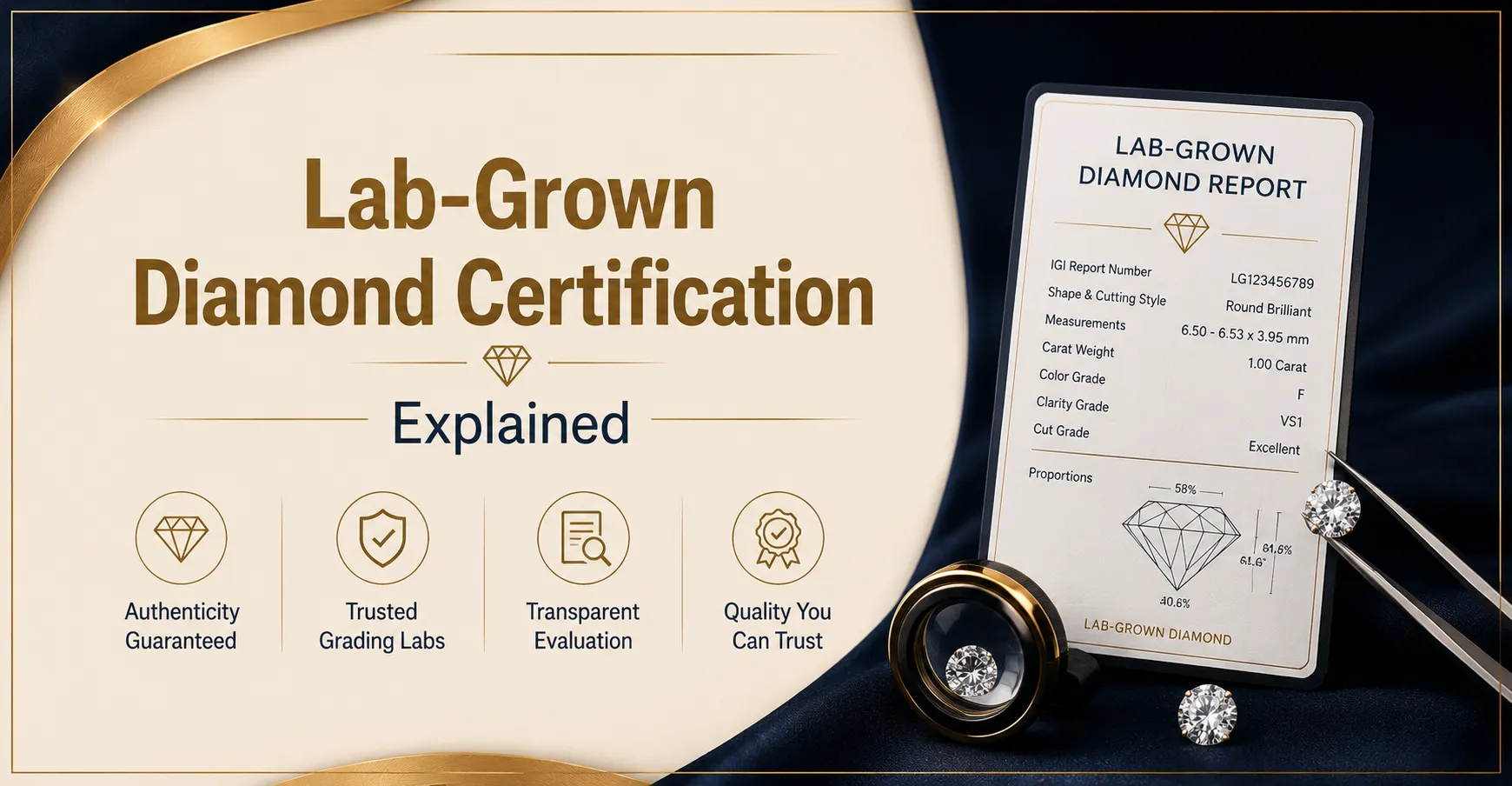
- A proper report may include details such as carat weight, color, clarity, cut, measurements, and laser inscription.
- Certification helps buyers compare diamonds more objectively.
- IGI is widely used for lab-grown diamonds.
- GIA also provides laboratory-grown diamond assessment services.
- Certification does not automatically mean a diamond is perfect; buyers still need to review the quality details.
- For custom jewelry, certification should be considered along with craftsmanship, metal quality, and CAD approval.
What Is Lab-Grown Diamond Certification?
Lab-grown diamond certification is an independent report that provides information about a diamond’s quality and characteristics.
It is usually issued by a gemological laboratory after the diamond has been examined by trained professionals using specialized tools.
A certification report helps confirm important details such as:
- Whether the diamond is lab-grown
- Diamond weight
- Quality grade
- Measurements
- Shape
- Proportions
- Polish
- Symmetry
- Identification details
In simple words, certification gives buyers proof beyond appearance.
A diamond may look beautiful online, but certification helps explain what makes it valuable.
Why Certification Matters When Buying Online
When buying lab-grown diamond jewelry online, buyers cannot physically inspect the diamond before purchase.
That makes certification even more important.
A grading report helps you:
- Verify diamond details
- Compare multiple stones
- Understand pricing
- Avoid vague quality claims
- Make a more informed decision
- Build trust with the jeweler
Without certification, buyers may only see general descriptions such as “premium quality,” “high sparkle,” or “excellent diamond.”
These terms sound attractive, but they do not provide enough proof.
Certification gives structure to the buying process.
Common Lab-Grown Diamond Certifications
IGI Certification
IGI, or International Gemological Institute, is one of the most commonly used grading laboratories for lab-grown diamonds.
Many lab-grown diamond buyers and jewelers rely on IGI reports because they provide detailed grading information in an easy-to-understand format.
An IGI lab-grown diamond report may include:
- Carat weight
- Color grade
- Clarity grade
- Cut grade
- Measurements
- Shape
- Polish
- Symmetry
- Growth method
- Laser inscription details
For buyers comparing lab-grown diamonds online, IGI certification can be very useful because it provides clear details about the stone.
GIA Reports and Assessments
GIA, or Gemological Institute of America, is one of the most recognized names in diamond grading.
GIA has updated how it evaluates laboratory-grown diamonds. Instead of using the same traditional natural diamond language in all cases, GIA now provides quality assessment terminology for lab-grown diamonds.
For buyers, this means it is important to understand what type of report or assessment is being provided and what information it includes.
A GIA report or assessment can help confirm the identity and quality category of a laboratory-grown diamond.
What Should a Diamond Report Include?
A proper lab-grown diamond report should give clear information about the diamond.
Here are the most important details buyers should check.
Carat Weight
Carat refers to the weight of the diamond.
Many buyers confuse carat with size, but carat measures weight, not exact visual appearance. Two diamonds with the same carat weight can look different depending on shape and cut.
Color
Color grade tells you how colorless the diamond appears.
For most buyers, near-colorless diamonds offer a good balance of beauty and value.
Clarity
Clarity measures internal and external characteristics.
Some inclusions are not visible to the naked eye, while others may affect appearance. A grading report helps buyers understand clarity before purchase.
Cut
Cut is one of the most important factors affecting sparkle.
A well-cut diamond reflects light better and often appears more brilliant than a larger diamond with poor cut quality.
Measurements
Measurements show the diamond’s actual dimensions.
This helps buyers understand how large the diamond may appear once set into jewelry.
Polish and Symmetry
Polish refers to the surface finish of the diamond.
Symmetry refers to how well the diamond’s facets align.
Both can affect visual performance and overall finish.
Laser Inscription
Some certified diamonds include a microscopic laser inscription on the girdle.
This inscription can help match the diamond to its report number.
Certification Does Not Replace Craftsmanship
Certification tells you about the diamond, but it does not tell you everything about the finished jewelry.
A certified diamond can still be placed in a poorly made setting.
That is why buyers should also check:
- Metal purity
- Stone setting quality
- Prong strength
- Finishing
- Design balance
- Comfort
- CAD approval for custom designs
For example, when buying a custom engagement ring or lab-grown diamond pendant, the diamond report confirms the stone quality, but craftsmanship determines how beautifully and securely the jewelry is made.
This is where custom jewelry expertise becomes important.
Certification vs Appraisal
Many buyers confuse certification with appraisal.
They are not the same.
| Factor | Certification | Appraisal |
| Purpose | Verifies diamond quality | Estimates jewelry value |
| Issued By | Gemological lab | Appraiser or jeweler |
| Focus | Diamond details | Replacement or insurance value |
| Used For | Quality comparison | Insurance or valuation |
A certification report helps you understand the diamond.
An appraisal helps estimate the value of the finished jewelry piece.
Both can be useful, but they serve different purposes.
Warning Signs Buyers Should Watch For
Be careful if a seller:
- Does not mention certification
- Avoids sharing grading details
- Uses vague words without proof
- Cannot explain diamond quality
- Does not provide stone specifications
- Offers unclear pricing
- Refuses to answer basic questions
A trustworthy jeweler should be comfortable explaining certification and helping buyers understand what they are purchasing.
Questions to Ask Before Buying a Certified Lab-Grown Diamond
Before purchasing, ask:
- Is the diamond certified?
- Which lab issued the report?
- Can I review the report before purchase?
- Does the report match the diamond?
- Is there a laser inscription?
- What are the diamond’s cut, color, clarity, and carat details?
- Is the diamond suitable for my jewelry design?
- Can I review CAD before production?
These questions are especially important for custom jewelry, where both the stone and the final design matter.
Why Certification Matters for Custom Jewelry
Custom jewelry gives buyers more control over design, materials, and final appearance.
But with that flexibility comes the need for clarity.
Certification helps confirm the diamond quality, while CAD approval helps confirm the final design.
Together, they give buyers better confidence before production begins.
For custom lab-grown diamond jewelry, buyers should review:
- Diamond report
- Stone size
- Metal type
- CAD design
- Setting style
- Production timeline
- Final specifications
This helps ensure the finished piece matches expectations.
Final Verdict
Lab-grown diamond certification is one of the most important things to check before buying diamond jewelry online.
It helps buyers verify quality, compare options, understand pricing, and avoid unclear claims.
However, certification should not be the only factor. The finished jewelry also depends on craftsmanship, metal quality, setting strength, and design execution.
For buyers creating custom lab-grown diamond jewelry, the best approach is to combine certified diamonds with transparent pricing, CAD approval, and expert craftsmanship.
Custom Karat helps buyers create personalized lab-grown diamond jewelry with certified stone options, premium metals, CAD design previews, and direct manufacturer pricing—making the buying process more transparent from selection to final production.
FAQs
What is lab-grown diamond certification?
Lab-grown diamond certification is a grading report that provides details about a diamond’s quality, origin, and characteristics.
Is IGI certification good for lab-grown diamonds?
Yes. IGI is commonly used for lab-grown diamonds and provides detailed grading information.
Does GIA certify lab-grown diamonds?
GIA provides laboratory-grown diamond assessment services. Buyers should review the report type and details before purchase.
What should I check in a diamond certificate?
Check carat weight, color, clarity, cut, measurements, polish, symmetry, and laser inscription details when available.
Is certification required for every lab-grown diamond?
For high-value jewelry, engagement rings, and custom diamond pieces, certification is strongly recommended.
Does certification prove the jewelry is high quality?
Certification verifies the diamond details, but jewelry quality also depends on metal, setting, craftsmanship, and finishing.
Can I customize jewelry with a certified lab-grown diamond?
Yes. Certified lab-grown diamonds can be used in custom engagement rings, pendants, earrings, bracelets, and other fine jewelry pieces.

About Author Brijesh Sharma
Brijesh Sharma is a jewelry retail industry author who shares expert insights on diamonds, lab-grown jewelry, custom designs, and smart jewelry buying. His content helps customers understand quality, pricing, trends, and craftsmanship so they can make confident jewelry purchase decisions.