No products added!


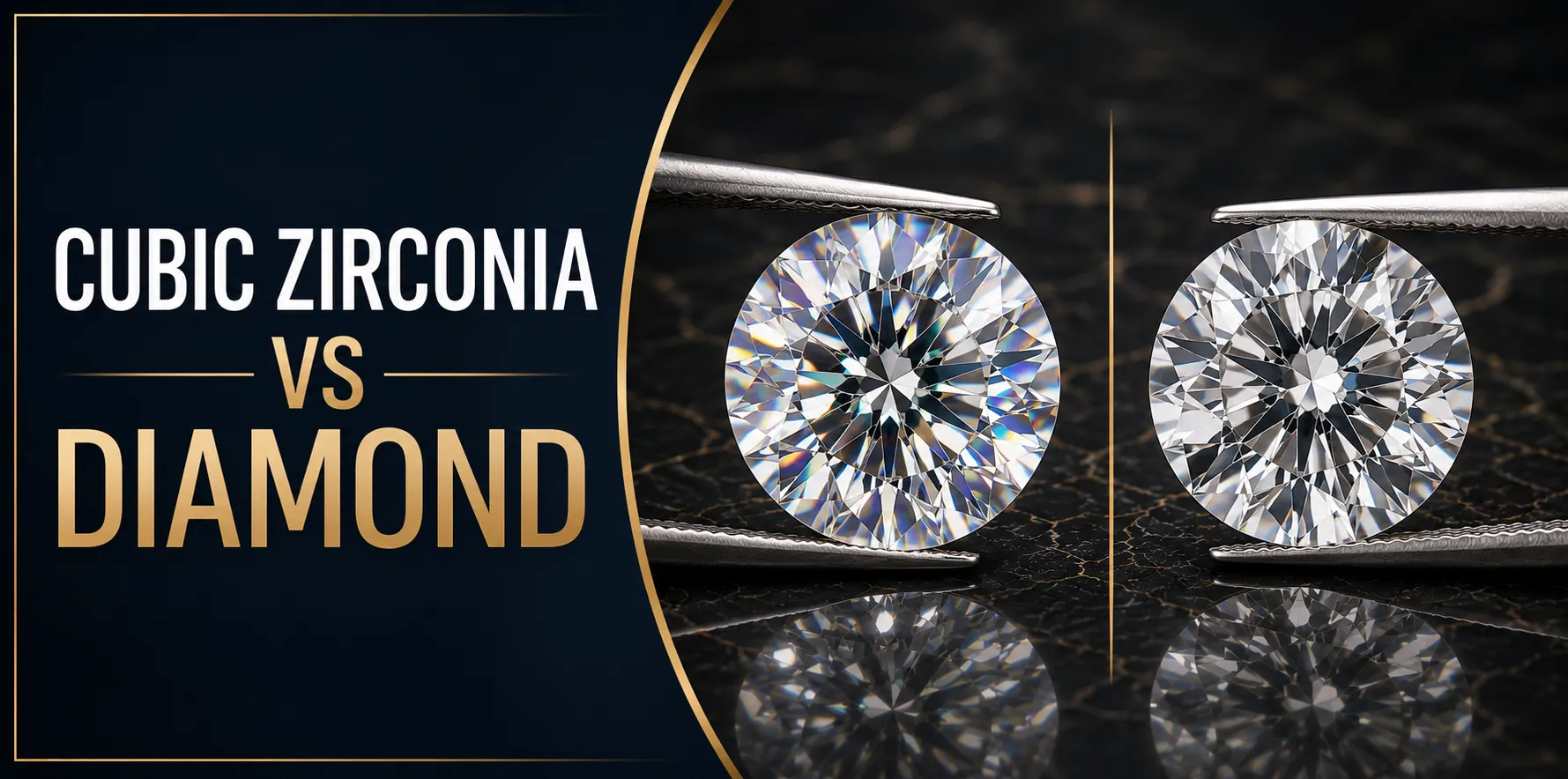
Cubic zirconia and diamond can look similar at first glance, especially in photos or under bright jewelry-store lighting. But they are very different stones.
A diamond is a real diamond, whether it is natural or lab-grown. Cubic zirconia, often called CZ, is a diamond simulant. It is made to imitate the look of diamond, but it is not diamond.
This difference matters when buying engagement rings, earrings, pendants, bracelets, necklaces, men’s jewelry, hip hop jewelry, or custom jewelry. A CZ stone may offer affordable sparkle, but it does not have the same composition, hardness, durability, value, or diamond identity.
This guide explains cubic zirconia vs diamond, how to tell the difference, which tests are useful, what buyers should avoid, and how Custom Karat helps customers choose the right stone with confidence.
Key Takeaways
- Cubic zirconia is not a diamond. It is a diamond simulant.
- A diamond may be natural or lab-grown, but both are real diamonds.
- GIA explains that common simulants such as cubic zirconia, moissanite, and glass are unrelated to diamonds at the atomic level.
- Cubic zirconia is usually much less expensive than diamond.
- Cubic zirconia has more fire but less brilliance than diamond, and it can yellow over time.
- CZ has a Mohs hardness of about 8.5, while diamond is harder and more durable for long-term daily wear.
- Diamonds are usually better for engagement rings, fine jewelry, heirloom jewelry, and premium custom jewelry.
- Cubic zirconia may work for fashion jewelry, travel jewelry, temporary rings, or low-cost sparkle.
- For important purchases, professional testing and clear disclosure are safer than relying only on at-home tests.
What Is Cubic Zirconia?
Cubic zirconia is a synthetic gemstone used as a diamond look-alike.
It is made to imitate the appearance of diamond but does not have the same chemical composition, crystal structure, hardness, or long-term value.
Cubic zirconia is also called:
- CZ
- Cubic zirconia stone
- Diamond simulant
- Simulated diamond
- American diamond in some markets
- Diamond alternative
Cubic zirconia is often used in:
- Fashion rings
- Low-cost earrings
- Travel jewelry
- Costume jewelry
- Temporary engagement-style rings
- Budget-friendly sparkle jewelry
What Is a Diamond?
A diamond is a real gemstone made of carbon atoms arranged in a diamond crystal structure.
Diamonds can be:
- Natural diamonds
- Lab-grown diamonds
Natural diamonds form underground. Lab-grown diamonds are created in controlled laboratory environments. Both are real diamonds, while cubic zirconia is not.
GIA explains that laboratory-grown diamonds have nearly the same chemical, optical, and physical properties as natural diamonds, although gemological laboratories can identify their different growth origin using advanced instruments.
Diamonds are used in:
- Engagement rings
- Wedding bands
- Earrings
- Necklaces
- Pendants
- Bracelets
- Men’s jewelry
- Hip hop jewelry
- Custom fine jewelry
Main Difference Between Cubic Zirconia and Diamond
The main difference is simple:
Diamond is real diamond. Cubic zirconia only looks like diamond.
| Feature | Diamond | Cubic Zirconia |
| Stone Type | Real diamond | Diamond simulant |
| Composition | Carbon diamond crystal | Different synthetic material |
| Appearance | Classic diamond brilliance | Bright, often more rainbow-like sparkle |
| Hardness | Extremely hard | Hard, but not as hard as diamond |
| Durability | Excellent for daily wear | Can scratch or dull faster |
| Price | Higher | Much lower |
| Certification | Can be graded by diamond labs | Usually not diamond-certified |
| Best For | Fine jewelry and long-term wear | Fashion and temporary jewelry |
Cubic Zirconia vs Diamond: Quick Comparison
| Factor | Diamond | Cubic Zirconia |
| Real Diamond? | Yes | No |
| Looks Like Diamond? | Yes, because it is diamond | Similar at first glance |
| Sparkle | Balanced brilliance and fire | Often more rainbow fire, less brilliance |
| Hardness | Excellent durability | Lower durability than diamond |
| Price | Higher | Lower |
| Daily Wear | Excellent | Better for occasional wear |
| Engagement Rings | Strong choice | Budget or temporary option |
| Long-Term Value | Stronger | Lower |
| Testing | Diamond testers and lab reports | May test differently |
| Certification | Available | Usually not diamond graded |
How to Tell the Difference Between Cubic Zirconia and Diamond
Some differences can be noticed visually, but the safest method is professional testing.
At-home checks can give clues, but they are not final proof. Lighting, setting style, stone size, and cut quality can affect how both stones appear.
For important purchases, always rely on:
- Certification
- Professional jeweler inspection
- Gemological testing
- Laser inscription verification
- Clear seller disclosure
1. Check the Sparkle
Diamond sparkle and cubic zirconia sparkle are different. Diamonds usually show a balanced mix of white brilliance, fire, and scintillation. Cubic zirconia can show more colorful fire but less brilliance than diamond, according to GIA.
What to Look For
A diamond often has sharper, more balanced sparkle. Cubic zirconia may appear overly rainbow-like or glassy, especially under strong lighting.
Smart Tip
If the stone looks extremely bright but slightly artificial, it may be cubic zirconia. Still, visual sparkle alone is not enough to confirm the stone.
2. Look at Durability and Surface Wear
Diamond is much harder than cubic zirconia. Cubic zirconia has a Mohs hardness of about 8.5. This makes it hard, but not as hard as diamond.
What to Look For
Over time, cubic zirconia may show:
- Scratches
- Rounded facet edges
- Cloudy appearance
- Dull surface
- Loss of sharp sparkle
Diamonds are much more resistant to scratching and are better for long-term daily wear.
Smart Tip
If an older stone looks cloudy, scratched, or worn down, it may be cubic zirconia or another simulant.
3. Compare Weight
Cubic zirconia is denser than diamond.
This means a cubic zirconia stone can feel heavier than a diamond of the same visible size. Gemological references commonly use density or specific gravity as one identification factor for gemstones.
What to Look For
If two loose stones look the same size, the CZ stone may feel heavier.
Smart Tip
This is difficult to judge once a stone is set in jewelry. Weight comparison is more useful for loose stones and professional testing.
4. Check Price
Price is one of the biggest clues.
Cubic zirconia is usually much cheaper than diamond. If a large “diamond” is being sold at an extremely low price, it may be CZ, moissanite, white sapphire, glass, or another simulant.
Smart Tip
If the price looks too good to be true, ask for stone details, certification, and clear disclosure before buying.
5. Look for Certification
Diamonds can be graded by gemological laboratories. A diamond report may include:
- Natural or lab-grown origin
- Shape
- Carat weight
- Color grade
- Clarity grade
- Cut grade
- Measurements
- Polish
- Symmetry
- Report number
- Laser inscription
Cubic zirconia is not graded like diamond because it is not diamond.
Smart Tip
For engagement rings and high-value jewelry, ask for certification or clear quality documentation.
6. Check the Laser Inscription
Many certified diamonds have a laser inscription on the girdle. This inscription can match the grading report number.
What to Look For
A jeweler may use magnification to check the inscription. If the report number matches the certificate, it gives more confidence that the stone is the described diamond.
Smart Tip
Not every diamond has a visible inscription, and not every inscription proves quality by itself. It should match trusted documentation.
7. Use a Diamond Tester Carefully
Diamond testers can help, but they are not perfect. Some testers measure thermal conductivity. Diamond conducts heat differently from many simulants, while cubic zirconia is not the same thermal conductor as diamond.
However, basic testers may not always identify every stone correctly, especially when comparing diamond, moissanite, and some treated or mounted stones.
Smart Tip
Use a diamond tester as a clue, not the only proof. For important jewelry, professional gemological testing is safer.
8. Fog Test
The fog test is a common at-home method.
Breathe on the stone and see how quickly the fog disappears. Diamonds disperse heat quickly, so fog may clear faster. Cubic zirconia may hold fog slightly longer.
Important Warning
This test is not fully reliable. Dirt, oil, room temperature, humidity, and stone setting can affect the result.
Smart Tip
Use the fog test only as a basic clue, not proof.
9. Water Test
Some people place a loose stone in water to see if it sinks. Diamonds are dense and usually sink. Cubic zirconia is also dense, so this test is not enough to separate CZ from diamond with confidence.
Smart Tip
Do not rely on the water test for serious purchases. It may help separate some low-density imitations, but it is not a reliable CZ vs diamond test.
10. Magnification Test
A jeweler can inspect the stone under magnification.
A Diamond May Show
- Natural or growth-related inclusions
- Sharp facet edges
- Strong polish
- Diamond-like internal features
- Laser inscription if certified
Cubic Zirconia May Show
- Very clean appearance
- Rounded facet edges over time
- Surface scratches
- Signs of wear
- Different optical behavior
Smart Tip
Magnification is useful, but it should be done by a trained professional.
11. Read-Through Test
The read-through test is sometimes used for loose stones. Place the stone flat-side down over printed text. A well-cut diamond bends light strongly, often making it difficult to read through. Some simulants may show text more clearly.
Important Warning
Cut quality and stone shape can affect this test. It is not reliable for mounted jewelry or fancy shapes.
12. Professional Gemological Testing
The safest way to tell the difference is professional testing.
A professional jeweler or gemological laboratory can check:
- Refractive behavior
- Thermal conductivity
- Magnification features
- Specific gravity
- Fluorescence
- Laser inscription
- Diamond report
- Natural vs lab-grown origin
- Simulant identification
Smart Tip
For engagement rings, high-value earrings, pendants, bracelets, or custom jewelry, professional verification is always better than guessing.
Cubic Zirconia vs Diamond: Sparkle Difference
Sparkle is one of the easiest differences to notice with practice.
Diamond sparkle usually appears sharper and more balanced. Cubic zirconia can look more fiery and rainbow-like, but sometimes less crisp.
| Sparkle Factor | Diamond | Cubic Zirconia |
| Brilliance | Strong white light return | Usually less diamond-like brilliance |
| Fire | Balanced rainbow flashes | Often more colorful fire |
| Scintillation | Sharp contrast and movement | Can look glassy or artificial |
| Long-Term Sparkle | Strong with proper cleaning | May dull with wear |
GIA notes that CZ has slightly more fire but less brilliance than diamond.
Cubic Zirconia vs Diamond: Hardness and Durability
Durability is one of the biggest practical differences.
Diamond is better for daily wear because it resists scratches extremely well. Cubic zirconia is hard, but it is not as hard as diamond.
| Feature | Diamond | Cubic Zirconia |
| Scratch Resistance | Excellent | Lower than diamond |
| Daily Wear | Excellent | Moderate |
| Long-Term Clarity | Strong | May become cloudy or scratched |
| Best Use | Fine jewelry | Fashion jewelry |
For engagement rings, wedding bands, tennis bracelets, and daily-wear pieces, diamond is usually the better choice.
Cubic Zirconia vs Diamond: Price Difference
Cubic zirconia is much cheaper than diamond. This makes CZ attractive for fashion jewelry, travel jewelry, and temporary pieces.
Diamonds cost more because they are real diamonds and are valued based on factors such as:
- Cut
- Color
- Clarity
- Carat
- Origin
- Certification
- Craftsmanship
- Market value
Smart Buying Tip
Low price is not automatically bad. It depends on the purpose. CZ can be fine for fashion jewelry. But if you want real diamond jewelry, engagement jewelry, or long-term value, diamond is the stronger choice.
Cubic Zirconia vs Diamond: Color and Clarity
Cubic zirconia is often made to look very white and very clean. This can sometimes make it look “too perfect” compared with many natural diamonds.
Diamonds come in different color and clarity grades. Some diamonds are colorless, while others show slight warmth. Some are very clean, while others contain inclusions.
| Factor | Diamond | Cubic Zirconia |
| Color | Graded from colorless to warm tones | Often very white |
| Clarity | Natural or growth-related features may appear | Usually very clean |
| Appearance | More natural variation | Can look overly perfect |
Smart Tip
A stone that looks perfectly colorless and flawless at a very low price is likely not a natural diamond and may be CZ or another simulant.
Cubic Zirconia vs Lab-Grown Diamond
Many buyers confuse cubic zirconia with lab-grown diamonds.
They are completely different.
| Feature | Lab-Grown Diamond | Cubic Zirconia |
| Real Diamond? | Yes | No |
| Composition | Carbon diamond crystal | Different synthetic material |
| Durability | Excellent | Lower than diamond |
| Price | Lower than many natural diamonds, higher than CZ | Very low |
| Certification | Available | Not diamond-certified |
| Best For | Fine jewelry and engagement rings | Fashion jewelry |
A lab-grown diamond is a real diamond created in a laboratory. Cubic zirconia is a diamond simulant.
Cubic Zirconia vs Natural Diamond
Natural diamonds and cubic zirconia can look similar from a distance, but they are not the same.
| Feature | Natural Diamond | Cubic Zirconia |
| Origin | Formed underground | Created as a simulant |
| Diamond Status | Real diamond | Not diamond |
| Value | Higher | Lower |
| Durability | Excellent | Lower |
| Certification | Available | Usually not diamond-certified |
| Best For | Fine jewelry and heirloom jewelry | Low-cost fashion jewelry |
Natural diamonds are chosen for rarity, tradition, and long-term diamond identity. CZ is chosen for affordability and diamond-like appearance.
Cubic Zirconia vs Moissanite vs Diamond
Cubic zirconia and moissanite are both diamond simulants, but they are not the same.
| Stone | Real Diamond? | Main Benefit | Main Consideration |
| Diamond | Yes | True diamond beauty and durability | Higher cost |
| Moissanite | No | Strong sparkle and good durability | Different fire from diamond |
| Cubic Zirconia | No | Very affordable sparkle | Lower durability and value |
For premium jewelry, diamonds are usually the strongest choice. For alternative jewelry, moissanite can be a stronger option than CZ because it is generally more durable.
For low-cost fashion jewelry, CZ may be enough.
Is Cubic Zirconia Good for Engagement Rings?
Cubic zirconia can be used in engagement-style rings, but it is usually not the best choice for long-term engagement jewelry.
An engagement ring is worn often and carries emotional value. Over time, CZ may scratch, dull, or lose its bright appearance.
Cubic Zirconia May Work If You Want:
- Temporary ring
- Travel ring
- Very low-cost ring
- Fashion ring
- Short-term sparkle
Diamond Is Better If You Want:
- Real diamond engagement ring
- Daily-wear durability
- Long-term value
- Certification
- Premium custom jewelry
- Heirloom-style piece
Is Cubic Zirconia Good for Earrings?
Cubic zirconia can work for low-cost fashion earrings.
Because earrings often experience less surface contact than rings or bracelets, CZ may last longer in earrings than in daily-wear rings.
However, for premium diamond studs, bridal earrings, or long-term fine jewelry, diamonds are the better choice.
Is Cubic Zirconia Good for Pendants?
Cubic zirconia can work for fashion pendants or occasional-wear pieces.
Pendants usually experience less abrasion than rings and bracelets, so CZ may be acceptable for budget jewelry.
For custom pendants, name pendants, cross pendants, heart pendants, or luxury gifts, lab-grown diamonds or natural diamonds offer stronger long-term value.
Is Cubic Zirconia Good for Bracelets?
Cubic zirconia is less ideal for bracelets because bracelets experience more movement, contact, and surface wear.
For tennis bracelets, Cuban bracelets, diamond bangles, or custom bracelets, lab-grown diamonds are usually a better choice.
Is Cubic Zirconia Good for Hip Hop Jewelry?
Cubic zirconia can create a low-cost iced-out look.
However, if the buyer wants real diamond sparkle, better durability, and premium fine jewelry value, lab-grown diamonds are the better option.
CZ May Work For:
- Costume hip hop jewelry
- Fashion pieces
- Temporary looks
- Budget styling
- Travel jewelry
Lab-Grown Diamonds Are Better For:
- Iced-out pendants
- Cuban chains
- Tennis chains
- Pinky rings
- Custom logo pendants
- Premium hip hop jewelry
Which One Should You Buy?
The right choice depends on your purpose.
Choose Diamond If You Want:
- Real diamond jewelry
- Engagement ring durability
- Premium sparkle
- Long-term value
- Certification
- Custom luxury jewelry
- Daily-wear performance
Choose Cubic Zirconia If You Want:
- Very low-cost jewelry
- Fashion sparkle
- Temporary jewelry
- Travel jewelry
- Costume jewelry
- A diamond-like look without diamond pricing
For most luxury jewelry buyers, diamond is the better choice. For short-term fashion use, cubic zirconia can be practical.
Common Buyer Mistakes
Thinking Cubic Zirconia Is a Lab-Grown Diamond
Cubic zirconia is not a lab-grown diamond. A lab-grown diamond is real diamond. CZ is only a diamond simulant.
Buying Only by Appearance
CZ can look attractive in photos, but it may not have the same durability, value, or long-term sparkle as diamond.
Ignoring Disclosure
Always check whether the stone is natural diamond, lab-grown diamond, cubic zirconia, moissanite, white sapphire, or another simulant.
Choosing CZ for Daily Engagement Jewelry
CZ may not hold up as well as diamond for daily engagement rings. If the ring is meant for long-term wear, diamond is usually better.
Trusting Only At-Home Tests
Fog, water, and read-through tests are not final proof. For valuable jewelry, professional testing is safer.
Not Checking Certification
For diamond jewelry, certification or clear quality documentation gives more confidence.
Expert Tips Before Buying
Ask What the Stone Actually Is
Do not rely on vague terms like “diamond look,” “American diamond,” “created stone,” or “simulated stone.”
Ask whether it is:
- Natural diamond
- Lab-grown diamond
- Cubic zirconia
- Moissanite
- White sapphire
- Glass
- Crystal
Choose Diamond for Fine Jewelry
If you want real diamond identity, choose natural or lab-grown diamonds.
Choose Cubic Zirconia for Fashion Jewelry
CZ is useful for low-cost fashion jewelry, travel pieces, or temporary sparkle.
Check Metal Quality
Even if the stone is diamond, poor metal can reduce value.
Check:
- Metal type
- Prong strength
- Setting security
- Clasp quality
- Bail strength
- Backing type
- Polish
- Comfort
Use CAD for Custom Jewelry
If the jewelry is custom, CAD helps you review the design before production. This is important for rings, pendants, bracelets, men’s jewelry, and hip hop jewelry.
Buyer Checklist Before Purchasing
Before buying cubic zirconia or diamond jewelry, check:
- Is the stone clearly described?
- Is it natural diamond, lab-grown diamond, or cubic zirconia?
- Do I want real diamond jewelry or fashion jewelry?
- What is my budget?
- Will I wear it daily or occasionally?
- Is certification available for diamond jewelry?
- What metal is used?
- Is the setting secure?
- Are the prongs strong?
- Is the clasp, bail, or backing strong?
- Is the price too low for the claimed stone?
- Is CAD approval available for custom jewelry?
- Is pricing transparent?
- Is shipping secure?
Final Verdict
Cubic zirconia and diamond may look similar at first, but they are not the same.
A diamond is a real diamond, whether natural or lab-grown. Cubic zirconia is a diamond simulant made to imitate diamond’s appearance.
If you want real diamond jewelry, long-term durability, certification, and premium value, choose natural or lab-grown diamonds. If you want a very low-cost stone for fashion, travel, or temporary jewelry, cubic zirconia may be suitable.
The smartest choice depends on your purpose.
Custom Karat helps buyers understand the difference between cubic zirconia, lab-grown diamonds, natural diamonds, moissanite, and gemstones so they can create jewelry with the right stone, metal, setting, and craftsmanship.
FAQs
Is cubic zirconia a real diamond?
No. Cubic zirconia is not a real diamond. It is a diamond simulant.
Is cubic zirconia the same as a lab-grown diamond?
No. A lab-grown diamond is a real diamond created in a laboratory. Cubic zirconia is not diamond.
How can you tell cubic zirconia from diamond?
You can look at sparkle, surface wear, price, certification, weight, and testing. However, professional inspection is the safest method.
Does cubic zirconia sparkle more than diamond?
Cubic zirconia can show more rainbow-like fire, but diamond usually has sharper brilliance and better long-term sparkle.
Is cubic zirconia good for engagement rings?
Cubic zirconia can work for temporary or travel rings, but diamond is usually better for long-term engagement rings.
Does cubic zirconia get cloudy?
Yes, cubic zirconia can become cloudy or dull over time, especially with daily wear and surface scratches.
Is cubic zirconia cheaper than diamond?
Yes. Cubic zirconia is usually much cheaper than natural or lab-grown diamonds.
Is cubic zirconia durable?
Cubic zirconia is hard, but it is not as hard or durable as diamond.
Can cubic zirconia pass as diamond?
It may look similar at first glance, but professional testing can identify the difference.
What is better, cubic zirconia or lab-grown diamond?
Lab-grown diamond is better for fine jewelry and long-term wear because it is real diamond. Cubic zirconia is better for low-cost fashion jewelry or temporary use.
Should I buy cubic zirconia or diamond earrings?
Choose cubic zirconia for low-cost fashion earrings. Choose lab-grown or natural diamonds for premium diamond earrings.
Can Custom Karat help me choose between cubic zirconia and diamond?
Yes. Custom Karat can help buyers compare lab-grown diamonds, natural diamonds, moissanite, colored gemstones, and other stone options based on style, budget, and jewelry purpose.

About Author Priyanka Kale
Priyanka Kale is a jewelry retail industry author who shares knowledge on diamonds, lab-grown jewelry, custom designs, and jewelry buying tips. Her content helps customers understand quality, pricing, trends, and craftsmanship before making confident jewelry purchase decisions.