No products added!


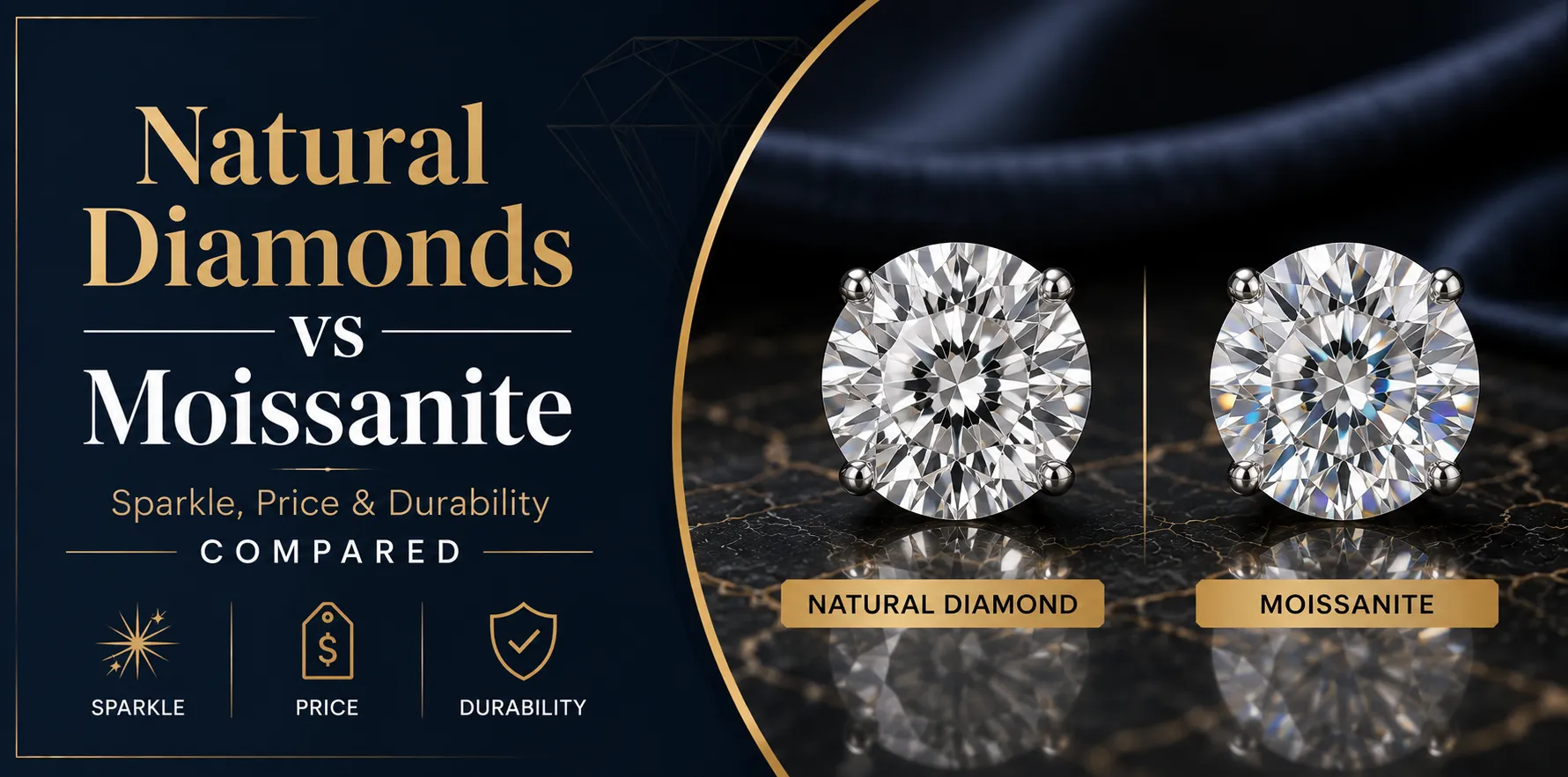
Natural diamonds and moissanite can both look beautiful in jewelry, but they are not the same.
A natural diamond is a real diamond formed underground over time. Moissanite is a diamond alternative that resembles diamond but has a different composition, sparkle pattern, price point, and long-term value.
This difference matters when buying engagement rings, wedding bands, earrings, pendants, bracelets, necklaces, men’s jewelry, hip hop jewelry, or custom jewelry. Moissanite may offer bright sparkle at a lower price, while natural diamonds offer traditional rarity, diamond identity, long-term desirability, and classic diamond brilliance.
This guide compares natural diamonds vs moissanite by sparkle, price, durability, value, testing, jewelry use, and buyer expectations so you can choose the right stone with confidence.
Key Takeaways
- Natural diamonds are real diamonds formed underground.
- Moissanite is not diamond. It is a diamond alternative and is commonly treated as a diamond simulant.
- GIA explains that moissanite is unrelated to diamond at the atomic level, even though it can imitate the appearance of diamond.
- Diamonds are the hardest material on earth and score 10 on the Mohs scale.
- Moissanite is also very durable and is commonly listed around 9.25 on the Mohs scale, making it suitable for many everyday jewelry designs.
- Moissanite usually costs less than natural diamond.
- Natural diamonds are usually better for buyers who want traditional rarity, real diamond identity, certification, heirloom appeal, and long-term luxury value.
- Moissanite can be a good option for buyers who want a lower-cost diamond alternative with strong rainbow-like sparkle.
- Sellers should clearly describe jewelry products and avoid misleading diamond, gemstone, or simulant claims.
- Custom Karat helps buyers compare natural diamonds, lab-grown diamonds, moissanite, colored gemstones, and other custom stone options.
What Is a Natural Diamond?
A natural diamond is a real diamond formed deep within the earth under extreme heat and pressure.
Natural diamonds are made of carbon atoms arranged in a diamond crystal structure. They are valued for their beauty, hardness, rarity, tradition, and long-standing role in engagement rings and fine jewelry.
Natural diamonds are commonly used in:
- Engagement rings
- Wedding bands
- Earrings
- Pendants
- Necklaces
- Bracelets
- Men’s rings
- Hip hop jewelry
- Custom fine jewelry
- Heirloom jewelry
Natural diamonds can be graded by recognized gemological laboratories, and a grading report may include the diamond’s cut, color, clarity, carat weight, measurements, polish, symmetry, and other details. GIA offers natural diamond grading reports for eligible loose natural diamonds.
What Is Moissanite?
Moissanite is a gemstone that resembles diamond but is not diamond.
It is commonly used as a diamond alternative because it is bright, durable, and usually more affordable than natural diamond. Moissanite has its own optical appearance and often shows stronger rainbow-like fire than diamond.
Moissanite can be used in:
- Engagement-style rings
- Earrings
- Pendants
- Bracelets
- Necklaces
- Men’s rings
- Fashion jewelry
- Custom jewelry
Moissanite can be beautiful, but it should be clearly understood as a diamond alternative, not a natural diamond.
Main Difference Between Natural Diamonds and Moissanite
The main difference is simple:
Natural diamonds are real diamonds. Moissanite is not diamond.
| Feature | Natural Diamond | Moissanite |
| Stone Type | Real diamond | Diamond alternative |
| Origin | Formed underground | Usually created for jewelry use |
| Diamond Status | Real diamond | Not diamond |
| Composition | Carbon diamond crystal | Different gemstone material |
| Sparkle | Classic diamond brilliance and fire | Strong rainbow-like fire |
| Durability | Excellent | Very good |
| Price | Usually higher | Usually lower |
| Certification | Diamond grading reports available | Not graded as diamond |
| Best For | Fine jewelry, engagement rings, heirloom jewelry | Budget-friendly sparkle and alternative jewelry |
Natural Diamonds vs Moissanite: Quick Comparison
| Factor | Natural Diamond | Moissanite |
| Real Diamond? | Yes | No |
| Looks Like Diamond? | Yes, because it is diamond | Similar, but different sparkle |
| Sparkle Style | Balanced brilliance, fire, and scintillation | More colorful rainbow fire |
| Price | Usually higher | Usually lower |
| Hardness | Mohs 10 | Around Mohs 9.25 |
| Daily Wear | Excellent | Very good |
| Engagement Rings | Traditional premium choice | Budget-friendly alternative |
| Long-Term Value | Stronger diamond identity and rarity | Lower traditional diamond value |
| Certification | Available | Not diamond-certified |
| Best For | Buyers who want real natural diamond | Buyers who want affordable sparkle |
Natural Diamonds vs Moissanite: Sparkle Compared
Sparkle is one of the biggest visual differences between natural diamonds and moissanite.
Natural diamonds show classic diamond brilliance, fire, and scintillation. Their sparkle is balanced and crisp, especially when the diamond is well cut.
Moissanite often shows more colorful rainbow-like flashes. Some buyers love this extra fire, while others feel it looks less like a traditional diamond, especially in larger stones or strong lighting.
Natural Diamond Sparkle
Natural diamonds are known for:
- White brilliance
- Balanced fire
- Sharp light return
- Crisp sparkle
- Classic diamond appearance
The quality of sparkle depends heavily on cut. A well-cut natural diamond can look bright, lively, and premium.
Moissanite Sparkle
Moissanite is known for:
- Strong fire
- Rainbow-like flashes
- Bright appearance
- More dramatic sparkle
- Different light behavior than diamond
Moissanite can appear more colorful than diamond under certain lighting.
Which Sparkles More?
Moissanite may show more rainbow-like fire, but natural diamonds offer the classic diamond sparkle most buyers expect from fine jewelry.
Smart Buying Tip
Choose natural diamond if you want traditional diamond brilliance.
Choose moissanite if you like strong rainbow sparkle and are comfortable choosing a diamond alternative.
Natural Diamonds vs Moissanite: Price Compared
Price is one of the biggest reasons buyers compare natural diamonds and moissanite.
Natural diamonds usually cost more because they are rare, mined, graded, and traditionally valued in fine jewelry.
Moissanite usually costs less because it is a diamond alternative and does not carry the same natural diamond rarity or market value.
| Stone | General Price Position |
| Natural Diamond | Usually highest |
| Lab-Grown Diamond | Usually lower than natural diamond |
| Moissanite | Usually lower than natural and lab-grown diamonds |
| Cubic Zirconia | Usually very low |
Why Natural Diamonds Cost More
Natural diamond pricing depends on:
- Rarity
- Cut
- Color
- Clarity
- Carat weight
- Shape
- Certification
- Market demand
- Origin
- Retail structure
Why Moissanite Costs Less
Moissanite usually costs less because it is not diamond and does not carry natural diamond rarity. This makes it attractive for buyers who want a bright stone at a lower price.
Smart Buying Tip
If your priority is the lowest upfront price, moissanite may be appealing.
If your priority is natural diamond identity, long-term luxury value, tradition, and rarity, natural diamond is the stronger choice.
Natural Diamonds vs Moissanite: Durability Compared
Both natural diamonds and moissanite are durable enough for many jewelry designs, but diamond is harder.
Diamonds score 10 on the Mohs hardness scale and are known as the hardest natural material.
Moissanite is also highly durable and commonly listed around 9.25 on the Mohs scale.
| Durability Factor | Natural Diamond | Moissanite |
| Mohs Hardness | 10 | Around 9.25 |
| Scratch Resistance | Excellent | Very good |
| Daily Wear | Excellent | Very good |
| Engagement Ring Use | Excellent | Good alternative |
| Long-Term Surface Wear | Stronger | Strong, but not diamond |
Smart Buying Tip
For daily fine jewelry and engagement rings, natural diamonds have the strongest hardness advantage.
Moissanite is still durable enough for many buyers, but it is not equal to diamond in hardness or diamond identity.
Natural Diamonds vs Moissanite: Appearance Compared
Natural diamonds and moissanite can look similar from a distance, but they are not visually identical.
Natural Diamonds Usually Look
- Classic
- Crisp
- Elegant
- Balanced
- Less rainbow-heavy
- More traditional
Moissanite Usually Looks
- Very bright
- More fiery
- More rainbow-like
- Sometimes slightly different in larger sizes
- Less traditionally diamond-like under close inspection
Smart Buying Tip
If you want a stone that looks closest to a traditional diamond, choose natural diamond. If you want a bright alternative and enjoy colorful fire, moissanite can be a good choice.
Natural Diamonds vs Moissanite: Color Compared
Natural diamonds are graded by color, usually from colorless to light yellow or brown in the standard D-to-Z scale.
Moissanite is often sold as colorless or near-colorless, but it may still show different undertones depending on the stone, size, and lighting.
| Factor | Natural Diamond | Moissanite |
| Color Grading | D-Z diamond color scale | Usually described as colorless, near-colorless, or tinted |
| Appearance | Depends on grade | May show different undertones |
| Best White Look | D-F natural diamond | Colorless moissanite |
| Value Option | G-H natural diamond | Near-colorless moissanite |
Natural Diamonds vs Moissanite: Clarity Compared
Natural diamonds may have inclusions and blemishes because they form underground.
Moissanite is often created for jewelry and may appear very clean to the eye.
| Factor | Natural Diamond | Moissanite |
| Clarity Features | Natural inclusions may appear | Often eye-clean |
| Grading | Diamond clarity scale | Not graded like diamond |
| Buyer Focus | Eye-clean diamond clarity | Overall stone appearance |
| Best Value | VS or eye-clean diamonds | Clean-looking moissanite |
Smart Buying Tip
For natural diamonds, choose eye-clean clarity instead of overpaying for flawless grades unless rarity is important to you.
For moissanite, focus on overall appearance, polish, cut, and whether the stone looks clean and bright.
Natural Diamonds vs Moissanite: Certification Compared
Natural diamonds can be graded by recognized diamond laboratories.
A natural diamond grading report may include:
- Natural diamond origin
- Shape
- Carat weight
- Color grade
- Clarity grade
- Cut grade
- Measurements
- Polish
- Symmetry
- Fluorescence
- Report number
- Laser inscription
GIA’s natural diamond grading services provide 4Cs-based reports for eligible loose natural diamonds.
Moissanite is not graded as diamond because it is not diamond.
Smart Buying Tip
For natural diamond engagement rings and high-value fine jewelry, ask for certification or clear diamond quality documentation.
For moissanite, ask for clear stone disclosure and quality details.
Natural Diamonds vs Moissanite: Testing Compared
Testing can help separate natural diamonds from moissanite. Visual appearance alone may not be enough, especially for buyers who are not trained.
Common verification methods include:
- Professional jeweler inspection
- Diamond tester
- Moissanite tester
- Magnification
- Refractive behavior testing
- Certification report verification
- Laser inscription check
- Gemological laboratory testing
The FTC notes that some thermal testers used to distinguish diamonds from cubic zirconia may not accurately identify moissanite, and moissanite may falsely register as diamond on that type of tester.
Smart Buying Tip
Do not rely only on a basic diamond tester. For important purchases, use certification, professional inspection, and clear seller disclosure.
Natural Diamonds vs Moissanite for Engagement Rings
Engagement rings are one of the most important jewelry purchases, so the stone choice matters.
Natural diamonds are usually better for buyers who want traditional diamond rarity, long-term luxury value, certification, and classic engagement ring identity.
Moissanite can work well for buyers who want a lower-cost engagement-style ring with strong sparkle.
Choose Natural Diamond Engagement Rings If You Want:
- Real natural diamond
- Traditional proposal symbolism
- Natural rarity
- Diamond certification
- Heirloom appeal
- Classic diamond sparkle
- Long-term luxury value
Choose Moissanite Engagement Rings If You Want:
- Lower upfront price
- Bright rainbow-like sparkle
- Diamond alternative
- Larger stone appearance for less cost
- Travel ring or temporary ring
- Non-diamond center stone
Smart Buying Tip
If the wearer specifically wants a diamond, choose a natural diamond or lab-grown diamond. If the wearer is open to diamond alternatives, moissanite can be considered.
Natural Diamonds vs Moissanite for Wedding Bands
For wedding bands, natural diamonds are often preferred because of their long-term symbolism and durability.
Moissanite can work in some bands, but buyers should understand that it is not diamond.
Best Choice for Traditional Wedding Bands
Natural diamonds are usually the stronger choice.
Best Choice for Budget-Friendly Sparkle
Moissanite may be considered for alternative wedding bands.
Natural Diamonds vs Moissanite for Earrings
Both natural diamonds and moissanite can work in earrings.
Natural diamond earrings are better for buyers who want fine jewelry value, classic diamond identity, and long-term wear.
Moissanite earrings can work for budget-conscious sparkle.
Smart Buying Tip
For premium diamond studs or meaningful gifts, natural diamonds are a stronger choice. For fashion earrings or lower-cost sparkle, moissanite can be considered.
Natural Diamonds vs Moissanite for Pendants
Natural diamond pendants are ideal for buyers who want real diamond jewelry with lasting value.
Moissanite pendants can work for buyers who want a diamond-like look at a lower cost.
Smart Buying Tip
For personalized luxury gifts, anniversary pendants, and heirloom-style pieces, natural diamonds are usually stronger.
For fashion pendants, moissanite can be practical.
Natural Diamonds vs Moissanite for Bracelets
Bracelets experience more movement and contact than many other jewelry pieces.
Natural diamonds are usually better for premium tennis bracelets, bangles, Cuban bracelets, and custom bracelets.
Moissanite may work for alternative bracelets, but buyers should consider durability, setting quality, and long-term expectations.
Natural Diamonds vs Moissanite for Men’s Jewelry
Men’s jewelry often includes bold rings, bracelets, chains, pendants, and earrings.
Natural diamonds are ideal for buyers who want traditional luxury, long-term value, and premium custom jewelry.
Moissanite can work for budget-conscious designs or buyers who prefer a lower-cost alternative.
Natural Diamonds vs Moissanite for Hip Hop Jewelry
Hip hop jewelry often uses many stones, so price differences can be significant.
Moissanite can create a lower-cost iced-out look, but natural diamonds offer real diamond identity and luxury value.
Natural Diamonds Are Better For:
- Premium iced-out pendants
- Luxury Cuban chains
- Heirloom-quality rings
- High-end custom pieces
- Buyers who want real diamond status
Moissanite May Work For:
- Budget iced-out jewelry
- Fashion hip hop pieces
- Travel jewelry
- Alternative sparkle
Which Looks More Like a Diamond?
Natural diamond looks like diamond because it is diamond.
Moissanite can look similar, but its fire, brilliance, and optical behavior can appear different.
| Stone | Looks Like Diamond? | Real Diamond? |
| Natural Diamond | Yes | Yes |
| Lab-Grown Diamond | Yes | Yes |
| Moissanite | Similar, but different sparkle | No |
| Cubic Zirconia | Similar at first glance | No |
If the goal is real diamond appearance and identity, natural diamond is the better choice.
Which Is Better: Natural Diamond or Moissanite?
The better choice depends on what you want.
Natural Diamonds Are Better If You Want:
- Real diamond jewelry
- Natural origin
- Traditional rarity
- Engagement ring symbolism
- Heirloom appeal
- Diamond certification
- Long-term luxury value
- Classic sparkle
- Premium custom jewelry
Moissanite Is Better If You Want:
- Lower upfront price
- Strong rainbow-like fire
- Diamond alternative
- Larger look for less cost
- Fashion jewelry
- Travel jewelry
- Temporary ring
- Budget-conscious custom piece
For most buyers seeking luxury fine jewelry, natural diamonds are the stronger choice. For buyers who want a lower-cost diamond alternative, moissanite can be a practical option.
Natural Diamond vs Moissanite vs Lab-Grown Diamond
Some buyers also compare lab-grown diamonds with natural diamonds and moissanite.
| Feature | Natural Diamond | Lab-Grown Diamond | Moissanite |
| Real Diamond? | Yes | Yes | No |
| Origin | Earth-formed | Laboratory-created | Diamond alternative |
| Cost | Usually highest | Usually lower than natural | Usually lower than both |
| Sparkle | Classic diamond sparkle | Classic diamond sparkle | More rainbow-like fire |
| Durability | Excellent | Excellent | Very good |
| Certification | Available | Available | Not diamond graded |
| Best For | Rarity and tradition | Real diamond value and customization | Budget sparkle |
Smart Buying Tip
Choose natural diamond for rarity and tradition. Choose lab-grown diamond for real diamond beauty with better value. Choose moissanite for lower-cost diamond-like sparkle.
Common Buyer Mistakes
Thinking Moissanite Is Diamond
Moissanite is not diamond. It is a diamond alternative and should be clearly described as moissanite.
Choosing Only by Sparkle
Moissanite may show strong fire, but sparkle alone does not make it a diamond. Consider identity, durability, value, and long-term expectations.
Ignoring Disclosure
Always check whether the stone is natural diamond, lab-grown diamond, moissanite, cubic zirconia, white sapphire, or another simulant.
Buying Moissanite When the Wearer Wants Diamond
If the wearer expects a real diamond, moissanite may not be the right choice. Choose natural or lab-grown diamond instead.
Not Checking Certification
For natural diamond jewelry, certification or clear diamond quality details are important, especially for engagement rings and larger stones.
Comparing Only Price
Moissanite usually costs less, but the final jewelry value also depends on metal, setting, craftsmanship, comfort, and long-term wear.
Trusting Only Basic Diamond Testers
Some testers may not separate moissanite from diamond correctly. Use proper verification for important purchases.
Expert Tips Before Buying
Decide Whether You Want Diamond or a Diamond Alternative
This is the most important decision. Natural diamond and moissanite are not the same, even if both can look beautiful.
Choose Natural Diamonds for Rarity and Heirloom Value
Natural diamonds are ideal for buyers who want traditional luxury, rarity, and long-term diamond identity.
Choose Moissanite for Budget-Friendly Sparkle
Moissanite is practical for buyers who want a lower-cost stone with strong fire and do not need real diamond identity.
Consider Lab-Grown Diamonds as a Middle Option
If natural diamond is above budget but you still want real diamond, lab-grown diamonds can be a strong option.
Prioritize Cut and Setting Quality
The stone is only one part of the jewelry.
Also check:
- Cut quality
- Metal type
- Prong strength
- Setting security
- Clasp quality
- Bail strength
- Backing type
- Polish
- Comfort
- Craftsmanship
Use CAD for Custom Jewelry
If the jewelry is custom, CAD helps you review the design before production. This is especially important for engagement rings, pendants, bracelets, men’s jewelry, and hip hop jewelry.
Buyer Checklist Before Purchasing
Before buying natural diamond or moissanite jewelry, check:
- Is the stone clearly described?
- Is it natural diamond, lab-grown diamond, or moissanite?
- Do I want real diamond jewelry or a diamond alternative?
- What is my budget?
- What is the jewelry type?
- Will I wear it daily or occasionally?
- Is diamond certification available?
- What is the stone shape?
- What is the stone size?
- What metal is used?
- Is the setting secure?
- Are the prongs strong?
- Is the clasp, bail, or backing strong?
- Is CAD approval available for custom jewelry?
- Is pricing transparent?
- Is shipping secure?
- Is the seller clear and trustworthy?
Why Custom Karat Helps Buyers Choose the Right Stone
Custom Karat helps buyers create jewelry with clarity, transparency, and confidence.
Instead of leaving buyers confused between natural diamonds, lab-grown diamonds, moissanite, and other stones, Custom Karat helps explain the differences clearly so buyers can choose based on style, budget, purpose, and long-term expectations.
Custom Karat offers:
Natural Diamond Options
Natural diamonds are ideal for buyers who prefer traditional rarity, earth-formed origin, and classic diamond luxury.
They work beautifully for engagement rings, wedding bands, earrings, pendants, bracelets, necklaces, men’s jewelry, hip hop jewelry, and custom designs.
Lab-Grown Diamond Options
Lab-grown diamonds are ideal for buyers who want real diamond sparkle with better value than many natural diamond options.
They are a strong choice for custom jewelry, engagement rings, earrings, pendants, bracelets, necklaces, men’s jewelry, and hip hop jewelry.
Moissanite Options
Moissanite can be considered for buyers who want a bright diamond alternative at a more accessible price.
This may work well for selected rings, earrings, pendants, and custom jewelry designs.
Colored Gemstone Options
Custom Karat can also help buyers explore sapphires, emeralds, rubies, birthstones, black diamonds, fancy color stones, and other gemstones for personalized designs.
Clear Stone Guidance
Custom Karat helps buyers understand exactly what they are choosing.
A natural diamond, lab-grown diamond, and moissanite should never be treated as the same thing.
Custom Design Support
Buyers can create jewelry from scratch or customize an existing design.
Custom options may include:
- Stone type
- Stone shape
- Stone size
- Metal type
- Setting style
- Engraving
- Finish
- Chain length
- Bracelet length
- Pendant size
- CAD design
CAD Design Previews
CAD previews help buyers review and approve the jewelry before production.
This helps confirm stone placement, metal thickness, setting security, engraving placement, and final proportions.
Premium Metal Options
Custom Karat offers multiple metal options, including 10K, 14K, 18K gold, yellow gold, white gold, rose gold, platinum, sterling silver, Argentium silver, gold vermeil, two-tone metals, and custom finishes.
Transparent Pricing
Pricing depends on stone type, stone quality, metal, setting, size, design complexity, and craftsmanship.
Custom Karat helps buyers understand where their budget goes.
Expert Craftsmanship
Each piece is made with attention to stone setting, metal finishing, polish, comfort, durability, and long-term wearability.
Secure USA Shipping
Finished jewelry is securely packed and shipped to customers in the USA. This gives buyers confidence when ordering custom jewelry online.
Final Verdict
Natural diamonds and moissanite can both be beautiful, but they are not the same.
A natural diamond is a real diamond formed underground. Moissanite is a diamond alternative with its own sparkle style, price point, and identity.
If you want traditional rarity, real diamond identity, heirloom appeal, certification, and classic luxury value, natural diamonds are the better choice.
If you want a lower-cost stone with bright rainbow-like sparkle, moissanite can be a good option for selected jewelry.
For buyers who want real diamond beauty at a lower cost than many natural diamonds, lab-grown diamonds can also be a strong middle option.
Custom Karat helps buyers compare natural diamonds, lab-grown diamonds, moissanite, and colored gemstones so they can create jewelry that feels personal, premium, and right for their needs.
FAQs
Is moissanite a natural diamond?
No. Moissanite is not a natural diamond. It is a diamond alternative with a different composition.
Is moissanite a real diamond?
No. Moissanite is not a real diamond. It can look similar to diamond, but it is a different gemstone.
Which sparkles more, natural diamond or moissanite?
Moissanite often shows more colorful rainbow-like fire, while natural diamonds show classic diamond brilliance and balanced sparkle.
Which is more durable, natural diamond or moissanite?
Natural diamond is harder and scores 10 on the Mohs scale. Moissanite is also durable and commonly listed around 9.25, but it is not as hard as diamond.
Which is more expensive, natural diamond or moissanite?
Natural diamond is usually more expensive than moissanite because of rarity, diamond identity, grading, market demand, and traditional luxury value.
Is moissanite good for engagement rings?
Moissanite can work for engagement rings if the buyer accepts that it is not diamond. If the buyer wants a real diamond ring, natural or lab-grown diamonds are better choices.
Can people tell moissanite from diamond?
Sometimes, especially in larger stones or strong lighting, moissanite’s rainbow-like fire can look different from diamond. Professional testing can identify the difference.
Does moissanite pass a diamond tester?
Some thermal testers may mistake moissanite for diamond, so proper testing and clear disclosure are important.
Should I choose natural diamond or moissanite?
Choose natural diamond if you want rarity, tradition, real diamond identity, certification, and long-term luxury value. Choose moissanite if you want lower-cost sparkle and are comfortable with a diamond alternative.
Is lab-grown diamond better than moissanite?
Lab-grown diamond is better if you want real diamond jewelry at a lower cost than many natural diamonds. Moissanite is better if you want a lower-cost diamond alternative.
Can Custom Karat make jewelry with natural diamonds or moissanite?
Yes. Custom Karat can help buyers create custom jewelry using natural diamonds, lab-grown diamonds, moissanite, colored gemstones, and other stone options based on style, budget, and purpose.

About Author Priyanka Kale
Priyanka Kale is a jewelry retail industry author who shares knowledge on diamonds, lab-grown jewelry, custom designs, and jewelry buying tips. Her content helps customers understand quality, pricing, trends, and craftsmanship before making confident jewelry purchase decisions.