No products added!

Gold jewelry has always been more than a fashion accessory. For generations, it has symbolized wealth, personal identity, celebrations, and family traditions. From engagement rings to personalized necklaces, gold jewelry often carries emotional significance that extends far beyond its material value.
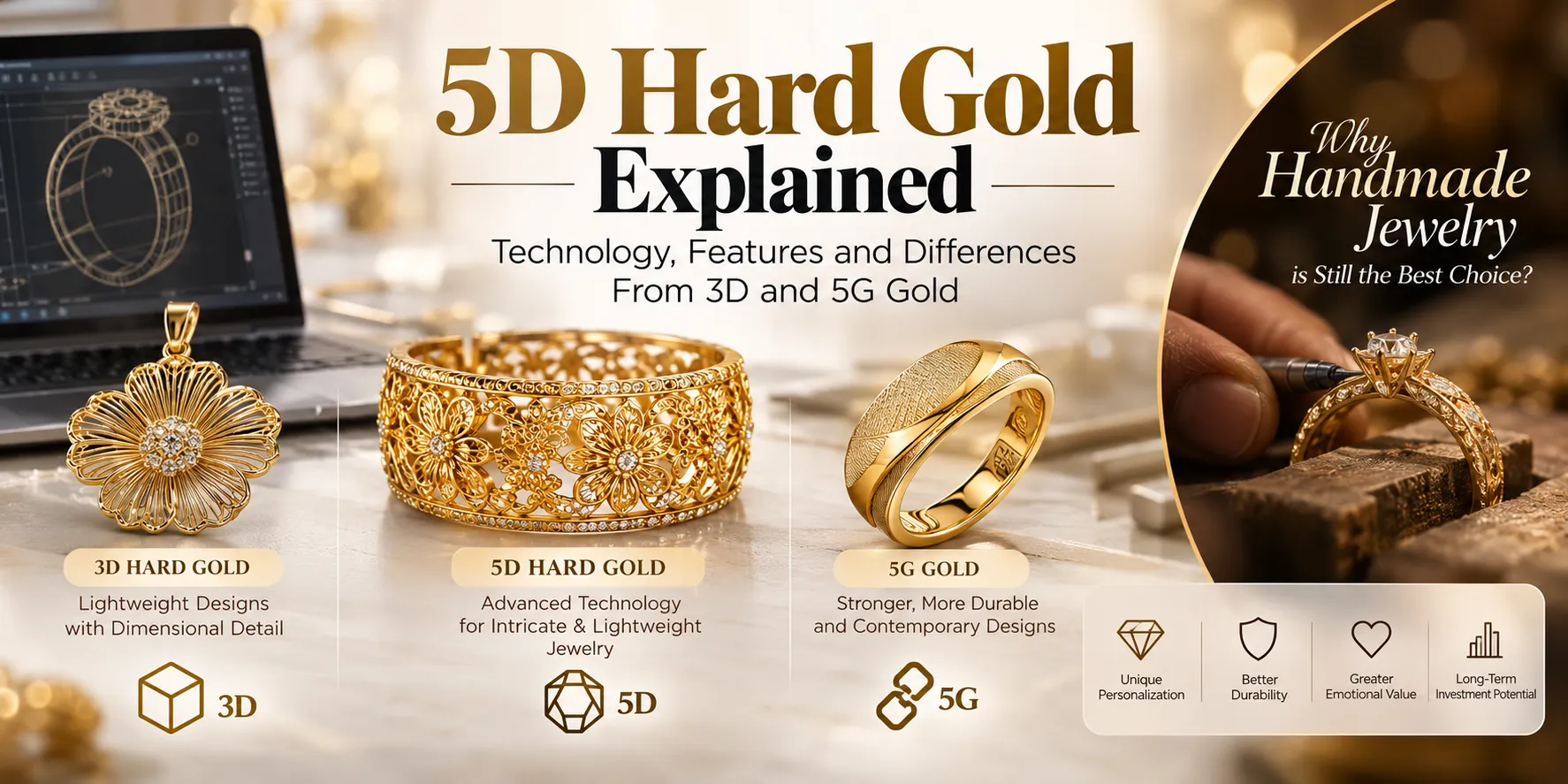
However, the jewelry industry has changed considerably with the introduction of advanced manufacturing technologies. Terms such as 3D hard gold, 5D hard gold, and 5G gold are increasingly used to describe jewelry designed to offer intricate detailing, greater hardness, and a substantial appearance without excessive weight.
Among these innovations, 5D hard gold has attracted attention for its lightweight construction and elaborate designs. But what exactly is 5D hard gold? How does it differ from 3D and 5G gold? And more importantly, is technologically manufactured jewelry necessarily a better choice than traditional handmade gold jewelry?
The answer depends on what matters most to the buyer.
While modern manufacturing technologies offer clear advantages in design and production, handmade jewelry continues to stand out for its personalization, craftsmanship, potential repairability, and long-term emotional value.
This guide explores the technology behind 5D hard gold, its advantages and limitations, the differences between modern gold manufacturing methods, and why custom handmade jewelry remains a compelling choice for fashion-conscious individuals and long-term jewelry owners.
What Is 5D Hard Gold?
5D hard gold is a commercial jewelry manufacturing term commonly associated with advanced electroforming processes that produce lightweight, detailed, and relatively rigid gold ornaments. Unlike conventional solid gold jewelry, many 5D hard gold products feature a hollow structure. This allows manufacturers to create larger-looking designs using less gold than would be required for an equivalent solid piece.
For example, a decorative pendant made using 5D hard gold technology may appear substantial while weighing considerably less than a traditionally manufactured solid gold pendant of similar dimensions. This makes the technology particularly attractive for fashion jewelry, statement earrings, decorative charms, and elaborate pendants.
However, one important distinction must be understood: 5D does not represent a standardized gold purity grade.
Gold purity is measured using karatage or fineness, such as 14K, 18K, 22K, or 24K. The term 5D refers to a manufacturing category rather than the amount of pure gold in the jewelry.
Key features of 5D hard gold
- Lightweight construction: Hollow designs reduce the amount of gold needed to achieve a substantial appearance.
- Intricate detailing: Electroforming allows complex patterns, textures, and sculptural shapes.
- Improved rigidity: Specialized manufacturing can increase hardness compared with untreated high-purity gold.
- Three-dimensional appearance: Jewelry can feature pronounced decorative surfaces and detailed contours.
- Modern finishing techniques: Manufacturers can create different textures, polished surfaces, and decorative effects.
- Design flexibility: The technology supports shapes that may be difficult or expensive to produce using some conventional manufacturing methods.
Although these features make 5D hard gold appealing, buyers should remember that hardness and durability are not the same thing. A hard but thin hollow structure can still be vulnerable to dents or deformation.
How Does 5D Hard Gold Technology Work?
The manufacturing process behind many 5D hard gold products involves electroforming, an electrochemical technique that deposits gold onto a specially prepared form.
Unlike conventional gold plating, which typically creates a relatively thin decorative coating, electroforming can build a thicker metal shell that forms the structure of the finished jewelry.
Step 1: Jewelry design and modeling
The process begins with creating a detailed jewelry design. Manufacturers may use computer-aided design (CAD), digital modeling, or traditional design techniques to develop the desired shape.
The design determines the jewelry’s appearance, dimensions, decorative details, and structural requirements.
Step 2: Preparing the core
A removable core, often made from wax or another suitable material, is prepared in the required shape.
This core acts as the temporary foundation onto which gold will be deposited. Where necessary, its surface is made electrically conductive.
Step 3: Gold electroforming
The prepared form is placed in an electroforming solution containing gold ions. Controlled electrical current causes gold to deposit onto the conductive surface, gradually building a metallic shell.
The thickness, hardness, and surface characteristics depend on the specific chemistry and processing conditions used.
Step 4: Removing the internal core
Once the required gold shell has formed, the temporary core is removed using a suitable method. This creates the hollow structure responsible for the jewelry’s relatively low weight.
Step 5: Surface finishing and polishing
The jewelry undergoes finishing processes to refine its appearance. Depending on the design, these may include polishing, texturing, decorative treatments, and additional detailing.
Step 6: Quality inspection
The finished jewelry should be inspected for structural integrity, surface quality, dimensions, weight, and gold fineness. Manufacturers may also perform hardness testing and other quality checks.
Why does this technology matter?
Electroforming gives manufacturers the ability to create visually elaborate jewelry without necessarily using the amount of gold required for a comparable solid piece.
However, this manufacturing advantage does not automatically translate into greater longevity or higher resale value. The final quality depends on factors such as shell thickness, design geometry, material purity, finishing, and how the jewelry is worn.
What Is the Difference Between 3D, 5D, and 5G Gold?
Although these names are frequently used together, they represent different commercial manufacturing categories.
There is no universally accepted technical standard establishing that every 5D product is superior to every 3D product or that 5G gold has one fixed composition.
| Feature | 3D Hard Gold | 5D Hard Gold | 5G Gold |
| Manufacturing concept | Three-dimensional hard gold processing | Refined hard gold processing, often electroforming | Specialized gold processing for hardness and formability |
| Construction | Often hollow | Often hollow | Solid or other construction, depending on product |
| Weight | Generally lightweight | Generally lightweight | Design-dependent |
| Hardness | Process-dependent | Process-dependent | Process-dependent |
| Design detailing | Decorative 3D patterns | Complex sculptural detailing | Contemporary and detailed designs |
| Flexibility | Often limited | Often limited | May offer improved formability |
| Repairability | Can be challenging | Can be challenging | Depends on construction |
| Gold purity | Must be verified | Must be verified | Must be verified |
| Typical application | Pendants, charms, earrings | Statement and decorative jewelry | Fashion jewelry and selected wearable designs |
3D Hard Gold: The development of lightweight dimensional jewelry
3D hard gold became popular because it allowed manufacturers to create dimensional gold jewelry with a substantial appearance and relatively low weight.
Its production is commonly associated with electroforming, although specific techniques vary. The resulting products can offer intricate patterns and greater rigidity than conventional high-purity gold jewelry.
However, many 3D hard gold designs have hollow interiors, which can make repairs more difficult.
5D Hard Gold: A refinement of hard gold manufacturing
5D hard gold is often marketed as a development of earlier 3D hard gold technology.
Manufacturers may focus on improved surface detailing, refined processing chemistry, or different hardness characteristics. The primary appeal remains the ability to create visually impressive gold jewelry with relatively lightweight construction.
But a product labeled 5D should not automatically be assumed to be more durable than a well-manufactured 3D piece.
5G Gold: A different approach to gold processing
5G gold is another commercial term used in the jewelry industry, particularly in Asian markets.
It is commonly associated with specialized manufacturing methods intended to combine attractive appearance, hardness, and formability. Unlike the hollow construction frequently associated with 5D hard gold, some 5G products may use solid construction.
Because the term is not a universal purity or manufacturing standard, buyers should verify the specific product’s composition and construction.
Advantages of 5D Hard Gold Jewelry
1. Lightweight and comfortable designs
One of the biggest advantages of 5D hard gold is its ability to produce larger-looking ornaments without excessive weight. This can be particularly useful for statement earrings and decorative pendants.
2. Intricate and fashionable appearance
Advanced manufacturing techniques allow elaborate patterns, textures, and sculptural designs. For customers interested in contemporary fashion jewelry, this provides a wide range of visual options.
3. Potentially lower gold weight
Because many designs are hollow, they can contain less gold than solid jewelry of comparable external dimensions. This may reduce the material cost, although specialized manufacturing charges can affect the final retail price.
4. Improved surface hardness
Certain electroforming processes can produce relatively hard gold structures. However, actual hardness varies between manufacturers and should be confirmed through technical specifications rather than marketing claims.
5. Efficient production of complex shapes
Electroforming can help manufacturers reproduce intricate designs consistently, making it useful for commercial jewelry collections.
Limitations of 5D Hard Gold Jewelry
Despite its advantages, 5D hard gold is not necessarily the best choice for every buyer.
Hollow construction can affect durability
A hollow gold ornament may be rigid but still susceptible to damage under concentrated pressure. For example, a thin hollow ring may be less suitable for demanding daily wear than a properly designed solid gold ring.
Repairs may be difficult
Damaged electroformed jewelry can require specialized techniques. Some hollow pieces may be difficult or uneconomical to repair, depending on the extent of the damage.
Resizing options can be limited
Certain hollow designs are unsuitable for conventional resizing. This matters particularly for rings and bracelets that may need adjustment over time.
Manufacturing premiums can affect resale value
Advanced processing and decorative finishing can increase retail prices. However, buyers should not assume those charges will be recovered when the jewelry is resold.
The manufacturing label does not guarantee purity
A product described as 5D hard gold must still be evaluated according to its verified gold fineness and weight. For these reasons, buyers should consider their intended use before choosing 5D hard gold over conventional or handmade jewelry.
Why Handmade Gold Jewelry Is Still a Better Choice for Many Individuals
Modern manufacturing technology can produce beautiful jewelry, but personal jewelry is about more than achieving an attractive shape. It is often purchased to celebrate an engagement, commemorate a relationship, express individuality, or preserve a meaningful memory.
This is where handmade and custom-designed jewelry can offer advantages that standardized manufacturing cannot always provide.
1. Handmade jewelry reflects your personal identity
Mass-produced jewelry is generally developed around designs intended to appeal to a broad audience.
Custom handmade jewelry can begin with the preferences and story of one individual. A buyer may choose the metal, gemstones, proportions, finish, engraving, and overall design to create something personally meaningful.
For example, instead of purchasing a standard gold pendant, someone might commission a necklace incorporating initials, a special date, or a meaningful symbol.
At Custom Karat, buyers can explore personalized jewelry designed around their preferences rather than relying exclusively on ready-made collections.
Why it matters: Fashion trends change, but a design connected to a meaningful personal experience can remain relevant for years.
2. Handmade jewelry can be designed for long-term durability
A skilled jeweler can consider how a piece will be worn before determining its construction.
For example, a custom engagement ring can be designed with an appropriate band thickness, secure gemstone settings, and an alloy suitable for regular wear. Similarly, a bracelet can be designed around wrist size, clasp security, and structural strength.
These considerations can make a substantial difference to long-term comfort and usability.
Handmade jewelry is not automatically stronger than machine-manufactured jewelry. However, custom production provides the opportunity to make structural decisions based on the individual wearer.
For customers seeking a personalized everyday piece, explore custom rings and jewelry designs.
3. Handmade jewelry offers greater fashion individuality
Fashion is increasingly about personal expression rather than following every passing trend.
A ready-made 5D hard gold pendant may be visually impressive, but its design may also be available to many other customers. A bespoke pendant or ring can incorporate details selected specifically for its owner.
Consider an engagement ring inspired by a couple’s story or a bracelet featuring a meaningful engraving. Such details make jewelry feel personal rather than interchangeable.
For buyers who value individuality, customization often matters more than whether a piece was manufactured using 3D, 5D, or 5G technology.
4. Handmade solid gold jewelry can offer better repairability
One practical advantage of many traditionally fabricated solid gold designs is their potential for repair and modification.
Depending on the alloy and construction, a qualified jeweler may be able to resize a ring, restore a finish, repair a connection, or modify a setting. These options are particularly valuable for jewelry intended to be worn over decades.
By comparison, thin hollow electroformed designs may have more limited repair possibilities. The difference is not simply handmade versus machine-made. It is primarily about material, construction, and the accessibility of future maintenance.
5. Handmade jewelry carries greater potential for emotional value
Imagine receiving two gold necklaces.
One is selected from a mass-produced fashion collection. The other is designed specifically for you, featuring a meaningful symbol and a personal engraving. Both may contain genuine gold and look beautiful.
But the second necklace tells a story. This emotional connection is difficult to reproduce through manufacturing technology alone.
For engagement rings, anniversary gifts, and family heirlooms, the meaning behind a piece can become more important than its original purchase price.
Handmade Gold Jewelry vs. 5D Hard Gold: Which Is Better for Investment?
Gold jewelry is often associated with financial security because gold itself has recognized market value. However, buying gold jewelry and investing in gold are not exactly the same thing.
Jewelry prices typically include the value of the metal, manufacturing costs, design charges, retail margins, and sometimes gemstones. These additional costs may not be recovered during resale.
Gold content matters more than manufacturing technology
Consider two pieces containing the same verified quantity and purity of gold.
One is handmade, while the other is produced using 5D electroforming. Their intrinsic gold content is essentially the same.
The manufacturing technique does not create additional gold value. For example, a 10-gram piece of 18K gold contains approximately 7.5 grams of pure gold, regardless of whether it is handmade or electroformed.
Its resale value will depend on prevailing gold prices, actual recoverable material, transaction costs, and the buyer’s policies.
Investment comparison: Handmade vs. 5D hard gold
| Investment factor | Handmade solid gold jewelry | 5D hard gold jewelry |
| Intrinsic gold value | Based on purity and weight | Based on purity and weight |
| Making charges | May be higher for custom craftsmanship | May include specialized processing premiums |
| Resale potential | Depends on gold content and buyer terms | Depends on gold content and buyer terms |
| Repairability | Often better for suitable solid designs | May be limited for hollow designs |
| Long-term wear | Can be designed for durability | Depends on wall thickness and construction |
| Emotional value | High potential through personalization | Depends on personal significance |
| Heirloom suitability | Strong potential with quality construction | Depends on structural durability |
| Guaranteed financial appreciation | No | No |
Why handmade jewelry may provide better long-term ownership value
For someone purchasing jewelry to wear regularly over many years, a well-constructed handmade piece may offer several advantages.
It can be designed around personal preferences, maintained by a qualified jeweler, and potentially modified as circumstances change. These benefits can improve its usefulness over time.
A hollow 5D hard gold ornament may look larger while containing less gold than a solid equivalent. This can be attractive for fashion, but it does not increase the underlying metal value. Therefore, buyers should distinguish between visual appearance and actual gold content.
Is handmade jewelry always a better financial investment?
No.
A heavily customized handmade piece may involve significant design and labor costs that are not fully recoverable at resale. Similarly, a high-purity 5D gold piece may retain meaningful metal value even if its construction is hollow.
For buyers primarily interested in financial returns, investment-grade gold bullion may be more appropriate than decorative jewelry.
But for individuals who want to combine gold ownership with fashion, personal meaning, and everyday usability, a thoughtfully designed handmade piece can offer greater overall satisfaction.
Why Handmade Jewelry Is Often Better for Long-Term Fashion
Fashion trends move quickly, and jewelry manufacturing technologies frequently introduce new textures, shapes, and decorative styles. But the best personal jewelry does not always follow the newest trend.
Timeless designs remain relevant
A classic solitaire ring, personalized gold pendant, or carefully designed bracelet can complement changing fashion preferences. These pieces are not necessarily tied to one manufacturing trend.
Custom jewelry can evolve with your lifestyle
A meaningful ring may eventually require resizing. A necklace may benefit from a different chain length. An heirloom piece may need restoration. Appropriately designed solid jewelry can sometimes accommodate these changes more easily than thin hollow pieces.
Personalized jewelry feels more exclusive
A custom design allows the wearer to influence proportions, metal selection, gemstone arrangement, and decorative details. That individuality can make a piece more meaningful than simply owning a popular design.
Craftsmanship can add lasting appreciation
Traditional jewelry-making skills, including hand fabrication, stone setting, engraving, and finishing, contribute to the character of a piece. The appeal comes not only from how the jewelry looks but also from the thought and skill involved in making it.
Can Handmade Jewelry and Modern Technology Work Together?
Absolutely.
Choosing handmade jewelry does not require rejecting modern manufacturing technology.
In fact, many custom jewelry businesses combine digital design tools with traditional craftsmanship. Computer-aided design can help customers visualize a ring or pendant before production.
Three-dimensional models can also help jewelers evaluate proportions, gemstone placement, and construction. Skilled craftspeople can then contribute through fabrication, setting, assembly, polishing, and finishing. This combination allows modern precision to support individual creativity.
It is important to understand that CAD-designed jewelry is not automatically the same as 3D hard gold or 5D electroformed jewelry. CAD is a design tool, while 3D and 5D hard gold are commercial manufacturing categories.
For customers interested in meaningful personalized jewelry, Custom Karat provides an opportunity to explore designs that combine individual preferences with professional jewelry-making techniques.
How to Choose Between 3D, 5D, 5G, and Handmade Gold Jewelry
The best choice depends on your purpose.
| Your priority | Recommended approach | Why |
| Lightweight statement earrings | Consider 5D hard gold | Large appearance with relatively low weight |
| Decorative fashion charms | Consider 3D or 5D hard gold | Intricate designs and dimensional details |
| Contemporary gold accessories | Compare suitable 5G designs | May offer useful combinations of hardness and formability |
| Daily-wear engagement ring | Well-constructed solid gold or platinum | Better potential for secure settings and maintenance |
| Personalized anniversary gift | Custom handmade jewelry | Greater design flexibility and emotional significance |
| Family heirloom | Durable bespoke solid jewelry | Long-term wear, maintenance, and personal meaning |
| Gold investment | Compare verified high-purity gold and bullion | Gold content and transaction costs matter most |
Why Choose Custom Karat for Personalized Gold Jewelry?
When purchasing jewelry for an important occasion, personal preferences deserve as much attention as appearance and material quality. Custom Karat focuses on personalized fine jewelry, offering buyers an alternative to selecting exclusively from standardized designs.
Whether you are looking for a meaningful engagement ring, a personalized necklace, or a distinctive gift, custom jewelry provides an opportunity to create something connected to your story.
Personalization beyond ready-made designs
Custom jewelry allows buyers to consider metal choices, gemstone arrangements, engravings, and individual design details.
Meaningful jewelry for important occasions
Engagements, anniversaries, birthdays, and personal milestones often deserve pieces that reflect the significance of the occasion.
A balance of technology and craftsmanship
Modern design techniques can support precision, while skilled jewelry-making practices contribute to the quality and character of the finished piece.
Jewelry designed around individual preferences
Rather than choosing a product simply because it uses a newer manufacturing technology, buyers can focus on comfort, style, significance, and intended use.
For those seeking jewelry that feels genuinely personal, explore Custom Karat’s fine jewelry collections and consider how a custom design can reflect your preferences.
Frequently Asked Questions About 5D Hard Gold
1. Is 5D hard gold real gold?
Yes, products described as 5D hard gold can contain genuine gold. However, the term does not guarantee a specific purity. Buyers should verify the gold fineness and supporting documentation.
2. Is 5D hard gold better than 3D hard gold?
Not necessarily. Although 5D is often marketed as a refinement of 3D hard gold, actual quality depends on the manufacturing process, construction, hardness, and finishing.
3. Is 5D hard gold the same as 24K gold?
No. 24K describes gold purity, while 5D describes a manufacturing category. A particular 5D product may contain high-purity gold, but this must be verified.
4. Is 5D hard gold suitable for everyday wear?
Some designs may be suitable for regular wear, but thin hollow pieces can be vulnerable to damage. Durability depends on construction and intended use.
5. What is the difference between 5D and 5G gold?
5D hard gold is commonly associated with refined electroforming and hollow designs. 5G gold is a separate commercial manufacturing category that may emphasize hardness and formability. Neither term guarantees a fixed purity or construction.
6. Can 5D hard gold jewelry be repaired?
Some pieces can be repaired by specialists, but hollow electroformed jewelry may be more difficult to restore than conventional solid gold designs.
7. Is handmade gold jewelry more durable than 5D hard gold?
A properly engineered solid handmade piece may be more practical for demanding daily wear than a thin hollow design. However, durability depends on construction quality, alloy, and design rather than manufacturing method alone.
8. Does handmade gold jewelry have better resale value?
Not automatically. Resale value primarily depends on recoverable gold content, gemstones, market prices, and buyer terms. Handmade craftsmanship may add artistic or sentimental value without guaranteeing a higher resale price.
9. Is 5D hard gold a good investment?
It may retain value through its gold content, but specialized manufacturing charges and resale deductions can affect returns. Buyers focused on investment should compare gold purity, weight, premiums, and buyback terms.
10. Why should individuals choose handmade jewelry over mass-produced gold jewelry?
Handmade or custom-designed jewelry provides greater opportunities for personalization, thoughtful construction, emotional significance, and potentially easier long-term maintenance.
11. Is 5D hard gold gold-plated?
Not necessarily. Electroforming can produce a structural gold shell, whereas conventional gold plating typically applies a thin decorative layer over another material.
12. Which is better for an engagement ring: 5D hard gold or handmade solid gold?
For most daily-wear engagement rings, a well-designed solid gold or platinum construction is generally more practical because it can support secure gemstone settings and future maintenance.
Why Handmade Jewelry Remains a Timeless Choice
5D hard gold represents an interesting development in jewelry manufacturing. Its lightweight construction, detailed appearance, and electroforming technology offer possibilities for fashionable gold accessories.
Similarly, 3D hard gold and 5G gold demonstrate how manufacturers continue to experiment with design, hardness, and production methods.
However, newer technology does not automatically mean better jewelry. For fashion-focused customers seeking lightweight statement pieces, modern hard gold designs can be attractive options.
But for individuals purchasing jewelry to celebrate relationships, express personal identity, or create a lasting heirloom, custom handmade jewelry often provides a more meaningful combination of individuality, craftsmanship, wearability, and long-term usefulness.
From an investment perspective, verified purity, actual gold weight, transparent pricing, and resale terms remain more important than whether jewelry is labeled 3D, 5D, or 5G.
Ultimately, jewelry should not be chosen solely because of the technology used to manufacture it. It should reflect the person who wears it and the purpose it is meant to serve. If you are looking for jewelry that tells your story rather than simply following the latest trend, explore Custom Karat and discover the possibilities of personalized fine jewelry.
References and Sources.
- https://www.metalsfocus.com/wp-content/uploads/2020/11/GOLD-FOCUS-2020.pdf
- https://www.cdocast.com/buyer_guide/5d-hard-gold-electroforming-process/
- https://www.gold.org/gold-standards/retail-gold-investment-principles
- https://www.royalmint.com/invest/discover/gold-news/metal-fineness-explained
- https://ydrintl.com/en/technologies-en/

About Author Priyanka Kale
Priyanka Kale is a jewelry retail industry author who shares knowledge on diamonds, lab-grown jewelry, custom designs, and jewelry buying tips. Her content helps customers understand quality, pricing, trends, and craftsmanship before making confident jewelry purchase decisions.