No products added!
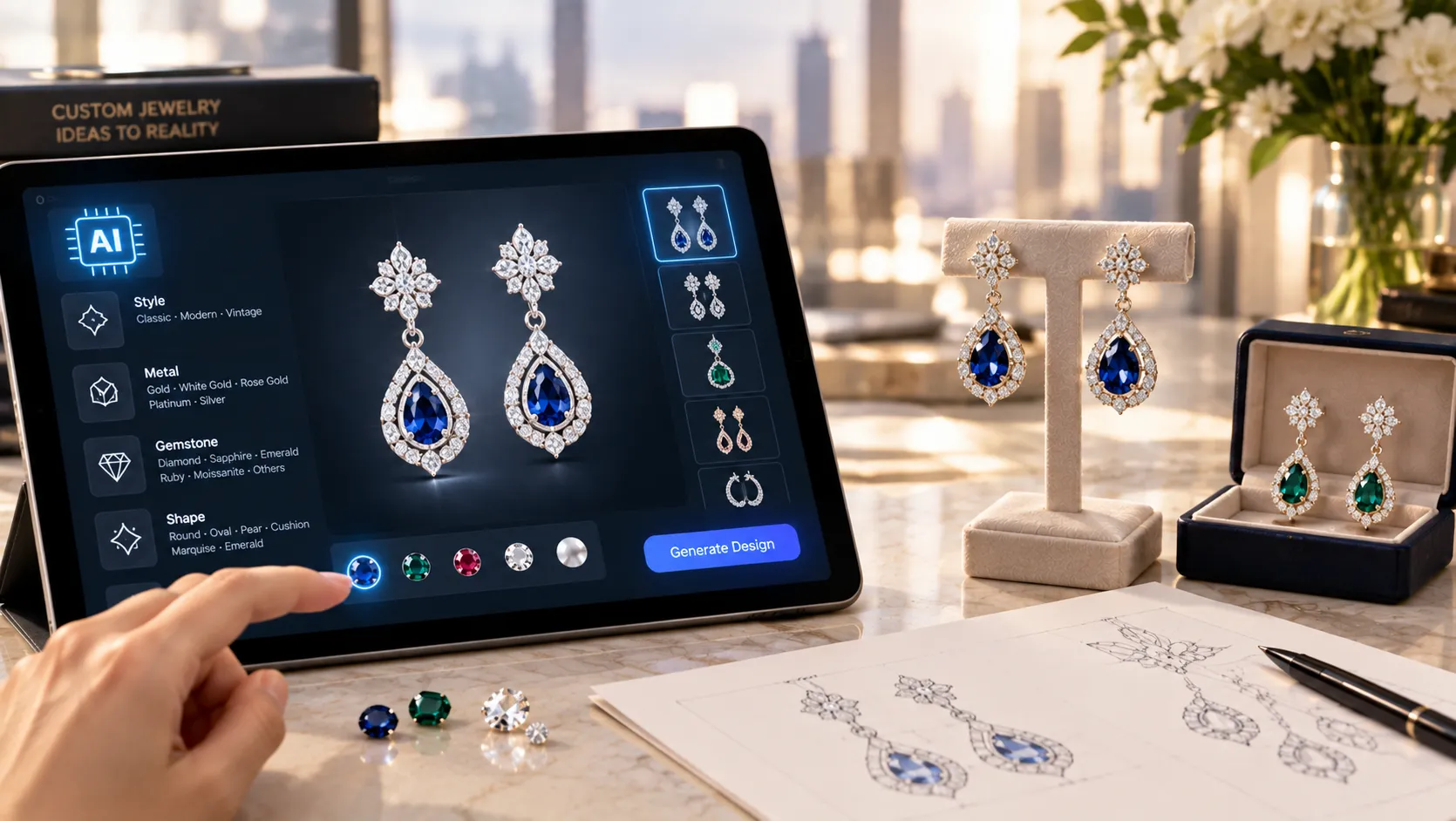
Designing a pair of custom earrings often begins with a simple idea. It could be a sketch, a gemstone you already own, a favorite design style, a family symbol, or simply an image of something you would like to create differently. Traditionally, turning that idea into jewelry requires a designer to interpret the concept, create a detailed design, develop CAD, and refine the piece before manufacturing.
Artificial intelligence is changing the early stages of this process. AI image-generation tools can transform written descriptions, sketches, and reference images into realistic earring concepts within minutes. This makes it easier to explore different shapes, metals, gemstones, settings, textures, and proportions before investing in detailed jewelry CAD.
However, an AI-generated earring image is not the same as a manufacturing-ready jewelry model. The most effective approach is to use AI for ideation and visualization, followed by professional jewelry design, CAD development, and manufacturing review.
What Is AI Earring Design?
AI earring design uses generative artificial intelligence to create visual jewelry concepts based on text prompts or reference images.
For example, a user could provide a prompt such as:
“Create a pair of 18K yellow gold drop earrings featuring pear-shaped emeralds surrounded by small round diamonds, with an elegant Art Deco-inspired geometric design.”
An AI image-generation system can interpret the description and produce a visual representation of the earrings.
The concept can then be modified. You might change the emeralds to sapphires, replace yellow gold with platinum, shorten the drops, remove the diamond halo, or create a more minimalist version.
The Gemological Institute of America has specifically examined generative AI for jewelry design and demonstrated earring concepts created through iterative AI prompting. Its research shows how a designer can generate several variations from an initial idea and progressively refine the selected concept.
How Does AI Earring Design Work?
1. Start With a Design Idea
You do not need a professional jewelry sketch to begin.
Your starting idea could be:
- Diamond stud earrings
- Gold hoop earrings
- Drop earrings
- Chandelier earrings
- Huggie earrings
- Pearl earrings
- Birthstone earrings
- Personalized earrings
- Initial earrings
- Gemstone earrings
- Men’s earrings
- Asymmetrical earrings
You can start with a basic description and add details as the concept develops.
2. Describe the Design
The more specific your prompt, the more control you generally have over the resulting concept.
Consider describing:
- Earring type
- Metal
- Gold karat
- Metal color
- Gemstones
- Diamond shapes
- Setting style
- Size
- Texture
- Finish
- Design inspiration
- Intended occasion
- Overall aesthetic
For example, instead of writing:
“Create gold earrings.”
you could write:
“Create a pair of contemporary 14K rose gold drop earrings featuring oval blue sapphires with a delicate diamond halo, polished finish, lightweight appearance and elegant proportions suitable for evening wear.”
This gives the AI significantly more information about what you want.
3. Generate Multiple Earring Concepts
The first AI-generated design does not have to be the final concept.
You can generate several variations and compare:
- Different gemstone shapes
- Different metal colors
- Different lengths
- Different setting styles
- Symmetrical versus asymmetrical designs
- Minimalist versus elaborate details
- Stud versus drop configurations
GIA’s research demonstrates this iterative process using AI-generated earring concepts. A selected image can be fed back into the system to generate further variations, allowing the design to gradually move toward a preferred direction.
This is one of the biggest advantages of AI in the early stages of jewelry design: rapid visual exploration.
Using Sketches and Reference Images
AI earring design does not have to begin with text alone.
If you have drawn an earring concept by hand, you can use the sketch as a reference image and ask an AI tool to turn it into a more realistic jewelry rendering.
For example, you might provide a basic sketch and request:
“Turn this sketch into a realistic 18K white gold earring with pavé diamonds and a polished finish while preserving the original silhouette.”
Modern image-generation tools support this type of reference-based workflow. Adobe Photoshop, for example, allows reference images to guide generated content based on either the visual style or composition of the reference.
This can be especially useful when a customer knows exactly what shape they want but does not have the skills to create a professional jewelry rendering.
What Types of Earrings Can You Design With AI?
AI can be used to explore a wide range of earring styles.
AI Stud Earring Design
Stud earrings are relatively simple in structure but can still offer extensive design possibilities.
You can experiment with:
- Solitaire diamonds
- Colored gemstones
- Cluster arrangements
- Geometric shapes
- Floral motifs
- Initials
- Personalized symbols
- Bezel settings
- Halo designs
For example, an AI prompt could explore a round diamond stud in platinum, then generate variations in yellow gold, rose gold, or different gemstone combinations.
AI Hoop Earring Design
AI can help visualize different hoop profiles, including:
- Classic hoops
- Thin hoops
- Chunky hoops
- Twisted hoops
- Pavé hoops
- Geometric hoops
- Hinged hoops
- Textured hoops
You can also experiment with different cross-sections, surface textures, stone placements, and decorative elements.
AI Drop and Dangle Earrings
Drop earrings provide greater scope for experimentation because the design can contain multiple components.
You can explore:
- Gemstone drops
- Diamond drops
- Geometric elements
- Floral designs
- Tassel-inspired forms
- Art Deco patterns
- Asymmetrical compositions
AI can help visualize how different proportions affect the overall appearance.
AI Chandelier Earrings
Chandelier earrings can contain numerous layers, stones, and decorative components. AI can quickly produce variations involving different silhouettes and gemstone arrangements.
However, complex chandelier designs require particularly careful professional review because weight, balance, attachment points, and comfort are important when turning the concept into a wearable piece.
Personalized Earrings
AI can also be useful for personalized designs involving:
- Initials
- Names
- Birthstones
- Dates
- Symbols
- Monograms
- Custom motifs
AI-generated lettering should be treated carefully because image-generation systems can distort or incorrectly reproduce text. The final lettering should be accurately recreated in professional CAD rather than relying on the generated image.
AI Earring Design vs. CAD Jewelry Design
An important distinction is the difference between AI visualization and jewelry CAD.
AI generates an image that communicates how an earring might look. CAD creates a structured three-dimensional model that can be developed according to specific jewelry and manufacturing requirements.
GIA’s CAD/CAM program covers creating jewelry models based on scale, proportion, element relationships, cost, size, style, manufacturing methods, and engineering fundamentals. It also covers creating manufacturable jewelry models and moving digital designs toward physical prototypes.
For earrings, professional CAD development may need to establish:
- Exact dimensions
- Metal thickness
- Stone dimensions
- Setting construction
- Prong placement
- Earring post dimensions
- Backing mechanism
- Hinge construction
- Weight
- Balance
- Wearability
- Manufacturing method
An AI image may show a beautiful pair of earrings with extremely thin elements, unsupported gemstones, or unrealistic connections. These issues need to be corrected before manufacturing.
Can an AI Earring Design Become Real Jewelry?
Yes, but the AI image normally needs to be translated into a professional jewelry design.
A practical workflow can be:
Idea → AI Concept → Design Refinement → CAD Model → Technical Review → Prototype → Manufacturing
The selected AI concept becomes a visual reference for the jewelry designer.
The designer can then recreate the design in CAD and establish precise dimensions and construction details.
The CAD model can be evaluated for:
- Structural strength
- Stone security
- Weight
- Balance
- Comfort
- Proportions
- Manufacturing feasibility
GIA’s Jewelry Design & Technology program emphasizes developing concepts in CAD according to engineering specifications and understanding the manufacturing challenges involved in producing the final jewelry.
Why AI Is Useful for Custom Earring Design
Faster Visualization
AI can turn a written idea into a visual concept much faster than traditional sketching or rendering.
This is useful when you know what you want but cannot easily explain the design visually.
More Design Variations
You can explore many possibilities before selecting a direction.
For example, one gemstone can be visualized in:
- Stud earrings
- Drop earrings
- Halo earrings
- Cluster earrings
- Geometric earrings
You can then compare the designs before proceeding to CAD.
Easier Customer-Designer Communication
A generated image gives both the customer and jewelry designer something concrete to discuss.
Instead of explaining that an earring should be “modern but inspired by vintage jewelry,” you can show a concept and identify exactly which elements you like.
Useful for Sketch-to-Render Workflows
One particularly useful application is converting a rough sketch into a more realistic visual rendering.
GIA describes this as a promising jewelry-design workflow because a designer or salesperson can start with a human-created sketch, use AI to visualize the concept, and refine the direction before spending substantial time developing a detailed CAD model.
Important Limitations of AI Earring Design
AI is useful for creative exploration, but it does not replace jewelry engineering.
AI May Create Impossible Structures
An AI-generated earring may contain:
- Unsupported gemstones
- Extremely thin metal
- Incorrect prongs
- Impossible connections
- Uneven symmetry
- Unrealistic backs
- Components that cannot move as shown
GIA’s research specifically identifies examples of AI-generated jewelry containing structural and setting irregularities and notes that these systems do not inherently understand what can actually be manufactured.
Weight and Comfort Are Difficult to Judge
An earring may look visually balanced in an image but be uncomfortable to wear if it is too heavy or poorly balanced.
This is particularly important for large gemstone earrings, chandelier earrings, and elaborate drop designs.
Gemstone Appearance Is Not a Specification
An AI-generated diamond or gemstone is a visual representation. It does not establish actual:
- Carat weight
- Dimensions
- Clarity
- Color
- Cut
- Origin
- Certification
Actual gemstone specifications must be selected separately.
AI-Generated Text May Be Incorrect
Names, initials and dates can be distorted. Always verify personalized elements before moving toward production.
How to Write Better AI Earring Prompts
A useful prompt can follow this structure:
Earring type + metal + gemstones + setting + design style + proportions + presentation
For example:
“Create a pair of elegant 18K yellow gold drop earrings featuring pear-shaped blue sapphires surrounded by small round diamonds, articulated drop construction, polished finish, balanced proportions and contemporary fine-jewelry styling. Photorealistic product rendering on a neutral background.”
You can then modify individual elements.
Change the metal:
“Replace the yellow gold with platinum.”
Change the gemstone:
“Replace the blue sapphires with emeralds.”
Change the style:
“Make the design Art Deco inspired with geometric lines and symmetrical detailing.”
Change the scale:
“Create a smaller, lightweight version suitable for everyday wear.”
This approach gives you more control than repeatedly starting with a completely new prompt.
AI Earrings for Different Occasions
The same design concept can be adapted for different purposes.
Everyday Earrings
Focus on smaller dimensions, simple settings, comfortable weight, and durable construction.
Bridal Earrings
AI can explore more elaborate combinations of diamonds, pearls, gemstones, halos and drop elements.
Anniversary Earrings
Personalized gemstones, meaningful motifs, dates, initials, or matching elements can be incorporated into the concept.
Statement Earrings
AI is particularly useful for experimenting with unusual silhouettes, oversized proportions, mixed materials and artistic forms.
Matching Jewelry Sets
You can also use AI to explore coordinated earrings, necklaces, pendants, and rings based on the same design language.
For example, a geometric diamond pendant can be used as the inspiration for a matching pair of earrings.
From AI Earring Concept to Finished Jewelry
The most practical approach is to combine AI’s speed with professional jewelry design expertise.
Begin with several concepts and identify the elements you want to keep. If you have a sketch, reference image, or existing jewelry piece that inspired you, include it as part of the design discussion.
Once the concept is selected, it can be developed into CAD with precise dimensions and engineering considerations.
The final CAD model should address:
- Stone security
- Metal thickness
- Earring weight
- Balance
- Post or hook construction
- Backing mechanism
- Wearability
- Manufacturing requirements
GIA’s CAD/CAM guidance emphasizes that professional jewelry models need to account for scale, proportion, element relationships, and manufacturing constraints rather than simply visual appearance.
Conclusion
AI earring design makes it easier to turn a simple jewelry idea into a visual concept. Whether you want diamond studs, personalized earrings, gemstone drops, hoops, chandelier earrings, or a completely original design, AI can help you explore possibilities quickly.
The important distinction is that AI creates the visual concept, while professional jewelry design and CAD turn that concept into a manufacturable piece. Structural strength, stone security, weight, comfort, proportions, and manufacturing methods still need to be evaluated before production.
For customers who have an AI-generated concept, sketch, or reference image and want to develop it into personalized jewelry, Custom Karat can help turn the creative direction into a custom earring design based on the preferred metal, gemstones, style, and requirements. AI can provide the starting point; professional jewelry design and manufacturing can take that idea toward a finished pair of earrings.
Reference URLs
- https://www.gia.edu/gems-gemology/fall-2024-artificial-intelligence-in-jewelry-design
- https://www.gia.edu/gem-education/program-jewelry-design-cad-cam
- https://www.gia.edu/gem-education/program-jewelry-design-technology
- https://helpx.adobe.com/photoshop/desktop/create-open-import-images/create-images/generate-images-using-reference-image.html
- https://helpx.adobe.com/in/photoshop/desktop/create-open-import-images/create-images/use-reference-images-for-consistent-results.html

About Author Priyanka Kale
Priyanka Kale is a jewelry retail industry author who shares knowledge on diamonds, lab-grown jewelry, custom designs, and jewelry buying tips. Her content helps customers understand quality, pricing, trends, and craftsmanship before making confident jewelry purchase decisions.