No products added!
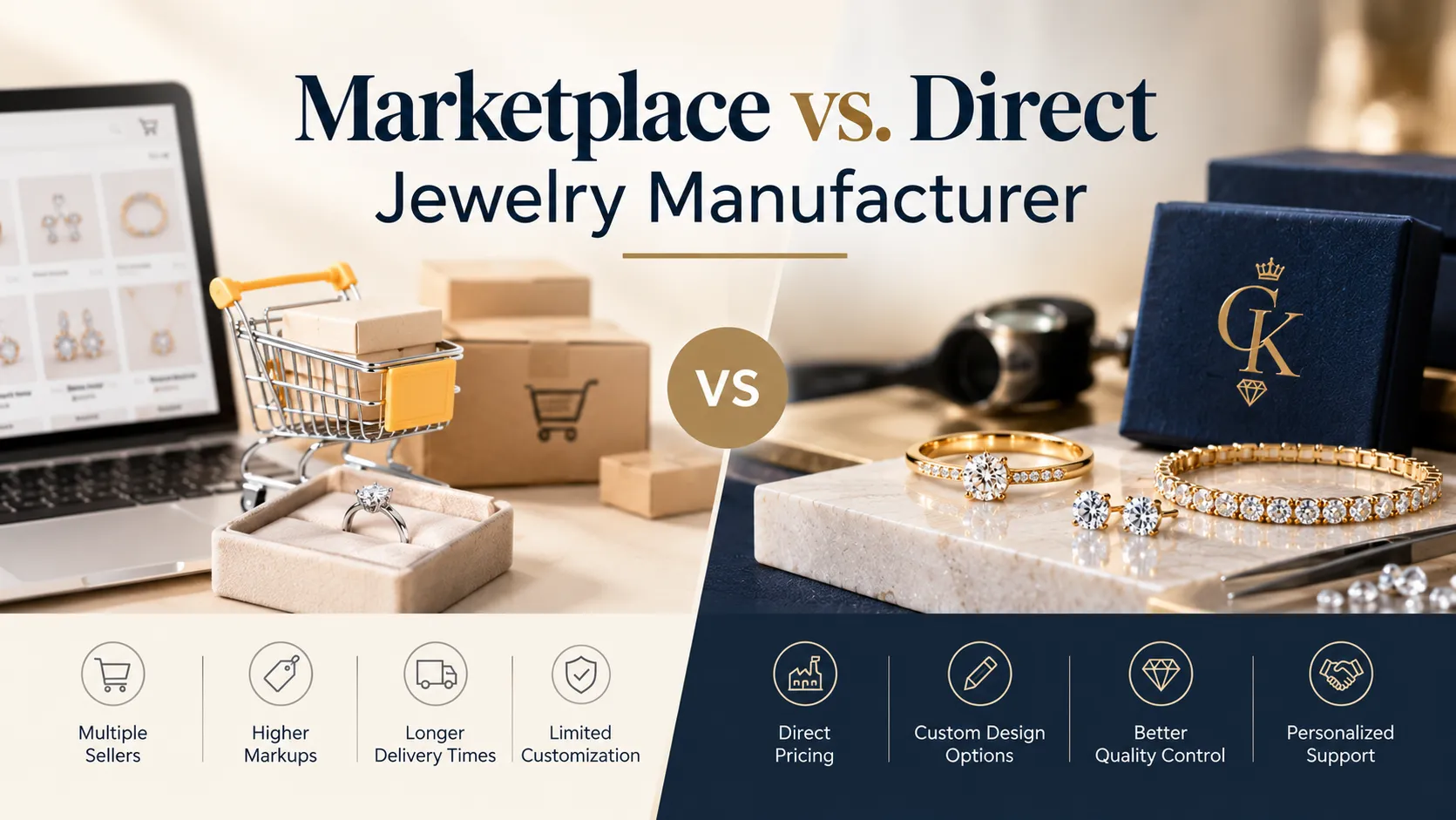
When shopping for custom jewelry, most buyers start with online marketplaces or consumer jewelry websites. These platforms make it easy to browse hundreds or thousands of designs, compare products, and place an order online.
But there is another option that is often overlooked:
Buying directly from a jewelry manufacturer.
A marketplace connects buyers with sellers or jewelry businesses through a platform. A direct jewelry manufacturer, on the other hand, works closer to individuals, or production of the jewelry.
For an individual looking for a custom ring, necklace, pendant, earrings, or chain, the difference can matter.
It can affect:
- How much customization is possible
- Who you communicate with
- How pricing is structured
- How much control you have over materials
- How your design is developed
- Whether the same design can be reproduced
- How closely you work with the manufacturer
So, is a jewelry marketplace or a direct manufacturer better for custom jewelry?
The answer depends on what you want from your purchase.
Marketplace vs. Direct Jewelry Manufacturer: At a Glance
| Factor | Jewelry Marketplace | Direct Jewelry Manufacturer |
| Main purpose | Connect buyers with sellers | Design and manufacture jewelry |
| Product selection | Usually broad | Based on manufacturing capabilities |
| Ready-made jewelry | Strong | May be available |
| Custom jewelry | Depends on seller | Core capability for custom manufacturers |
| Individual buyers | Yes | Yes, if manufacturer offers D2C |
| Direct manufacturer communication | Usually not | Yes |
| Design from your idea | Depends on seller | Yes |
| CAD/3D design | Seller-dependent | Often available |
| Material customization | Seller-dependent | Often more flexible |
| Pricing | Seller’s retail price | Custom manufacturing quotation |
| Production transparency | Varies | Generally closer to production |
| Repeat production | Seller-dependent | Possible |
| Private label | Limited/varies | Yes, depending on manufacturer |
| Best for | Browsing and comparing products | Customization and direct production |
What Is a Jewelry Marketplace?
A jewelry marketplace is an online platform where customers can discover and purchase jewelry from sellers.
Depending on the marketplace, you may find:
- Independent jewelry designers
- Small jewelry businesses
- Manufacturers
- Resellers
- Handmade jewelry sellers
- Vintage jewelry sellers
- Custom jewelry providers
The marketplace provides the platform, while individual sellers are generally responsible for the products they list.
This can give customers a large selection of jewelry in one place.
However, the marketplace itself may not be the company manufacturing your jewelry.
What Is a Direct Jewelry Manufacturer?
A direct jewelry manufacturer is a company involved in producing jewelry and, in a direct-to-consumer model, allows individual customers to work with it directly.
Instead of purchasing a finished product from a marketplace seller, the customer can communicate with the manufacturer about the actual jewelry they want to create.
For example:
Your idea → CAD → Design approval → Manufacturing → Finished jewelry
This is particularly useful when you don’t want to simply select an existing product.
You want to create something of your own.
Marketplace vs. Manufacturer: The Biggest Difference
The simplest way to understand the difference is:
Marketplace
Platform → Seller → Customer
Direct Manufacturer
Manufacturer → Customer
The marketplace model gives you access to many sellers.
The manufacturer-direct model gives you closer access to the production source.
Neither model is automatically better for every purchase.
The right choice depends on whether your priority is selection or customization and manufacturing access.
1. Pricing: Marketplace vs. Direct Manufacturer
This is one of the most important differences for a price-conscious custom jewelry buyer.
A marketplace listing usually shows you the seller’s final selling price.
That price can include:
- Material
- Labor
- Manufacturing
- Design
- Seller’s business costs
- Marketplace fees
- Packaging
- Marketing
- Shipping
- Other operating costs
The exact pricing structure varies from seller to seller.
With a direct manufacturer, the quotation can be closer to the actual requirements of the manufacturing project.
For example:
Custom Jewelry Cost
Metal
+
Diamond/Gemstone
+
CAD/Design
+
Manufacturing/Labor
+
Finishing
+
Certification, if required
+
Shipping/Applicable Taxes
Final Price
This doesn’t mean a manufacturer is always cheaper.
That’s an important distinction.
A direct manufacturer may offer a different cost structure because you are working closer to the production source, but the final price still depends on your specific design and materials.
The better question is:
“What am I paying for?”
rather than simply:
“Which option is cheaper?”
2. Customization
Marketplace customization depends heavily on the individual seller.
Some sellers may offer:
- Ring-size changes
- Metal changes
- Engraving
- Stone changes
- Minor design modifications
Others may offer complete custom design.
A direct jewelry manufacturer can potentially work from the beginning of the design process.
You could provide:
- A photograph
- A sketch
- A CAD file
- An existing piece
- A reference design
- A completely new concept
The manufacturer can then determine how the design can be converted into a production-ready piece.
3. Designing Jewelry From Scratch
Suppose you don’t like anything available in a marketplace.
You have your own idea.
For example:
“I want an 18K gold pendant with this shape, this gemstone and these dimensions.”
On a marketplace, you need to find a seller willing and capable of creating it.
With a direct manufacturer, the conversation can begin with the manufacturing requirements.
The workflow can be:
Idea
↓
Design Development
↓
CAD
↓
3D Rendering
↓
Approval
↓
Manufacturing
↓
Finishing
↓
Quality Check
↓
Finished Jewelry
This is particularly useful for genuinely custom jewelry rather than simple product personalization.
4. Communication With the Person Making Your Jewelry
With a marketplace, you typically communicate with the seller through the marketplace’s messaging system or customer service process.
The seller may or may not be the manufacturer.
With a direct manufacturer, the objective is different:
You communicate directly with the company responsible for manufacturing your jewelry.
This can make discussions around technical requirements easier.
For example:
- Exact dimensions
- Metal weight
- Stone setting
- Prong design
- Finish
- Thickness
- Engraving
- CAD changes
- Production requirements
Instead of simply asking:
“Can you customize this product?”
you can discuss:
“Can this design be manufactured with these specifications?”
5. Material Flexibility
Marketplaces can provide an enormous variety of materials because multiple sellers are present.
But the options available for a particular design depend on the seller.
A direct manufacturer may be able to discuss material specifications based on its production capabilities.
For example:
- Silver
- 14K gold
- 18K gold
- Platinum
- Different finishes
- Different gemstone options
- Different metal weights
The important point is that capabilities vary by manufacturer, so buyers should confirm the available materials before placing an order.
6. Who Actually Makes the Jewelry?
This is an important question that buyers often don’t ask.
When purchasing through a marketplace: Who is actually manufacturing the jewelry?
It could be:
- The marketplace seller
- A small jewelry studio
- A manufacturer
- A third-party production company
- Another supplier
With a direct manufacturer, the answer is much more straightforward:
You are dealing with the company responsible for manufacturing the jewelry.
For customers who care about production transparency, this can be a significant advantage.
7. One Custom Piece vs. Repeat Production
A marketplace can be excellent when you want to discover something unique and purchase one piece.
But what happens if you love the design and want:
- Another size?
- Another metal?
- Another gemstone?
- Matching earrings?
- A matching necklace?
- Five pieces for your family?
- The same design again later?
A direct manufacturer can potentially support this type of repeat production.
This is one reason manufacturers are particularly relevant not only to individual customers but also to:
- Jewelry brands
- Designers
- Retailers
- E-commerce businesses
- Private-label businesses
8. Can an Individual Buy Directly From a Jewelry Manufacturer?
Yes.
You don’t necessarily need to:
- Own a jewelry store
- Be a retailer
- Place a large wholesale order
- Have a jewelry brand
to discuss a custom jewelry project with a manufacturer that accepts individual orders.
A direct-to-consumer manufacturer can work with an individual customer who simply wants to create a custom piece.
That changes the traditional perception of jewelry manufacturing.
You don’t have to buy from the retail shelf.
You can start with your own idea and go directly to the source.
9. Why Buy Direct From CustomKarat?
CustomKarat’s direct-from-manufacturer model allows individual customers to explore custom jewelry without relying exclusively on marketplace listings.
You can start with:
Your Idea
Whether it’s a:
- Reference image
- Sketch
- Existing design
- Personal concept
- Custom gemstone combination
- Specific metal requirement
the project can move toward a production-ready design.
CustomKarat’s approach:
Idea → Custom Design → CAD → Approval → Manufacturing → Finished Jewelry
This provides a direct connection between the customer and the manufacturing process.
10. Is CustomKarat Cheaper Than a Marketplace?
The most credible answer is:
It depends on the jewelry.
A direct manufacturer should not be promoted simply by claiming that every piece will be cheaper than every marketplace listing.
Jewelry prices vary based on:
- Metal
- Weight
- Gemstones
- Diamond specifications
- Design complexity
- Labor
- CAD
- Finishing
- Quantity
- Shipping
Instead, CustomKarat’s advantage can be positioned around:
Direct pricing based on your actual requirements.
Rather than selecting a marketplace listing and accepting its final price, you can discuss the specifications of your jewelry directly with the manufacturer.
That gives you a better opportunity to understand where your money is going.
11. When Should You Choose a Marketplace?
A marketplace may be the better choice if you:
- Want to browse a large number of designs
- Are looking for ready-to-ship jewelry
- Want to compare many independent sellers
- Want handmade or vintage options
- Already know the exact product you want
- Prefer a marketplace shopping experience
12. When Should You Choose a Direct Jewelry Manufacturer?
A direct manufacturer may be a better fit if you:
- Have your own jewelry idea
- Want a completely custom piece
- Want to modify an existing design
- Want to choose specific materials
- Want CAD/design development
- Want to communicate directly with the manufacturer
- Want greater visibility into manufacturing-related costs
- Want to reproduce a design later
- Want multiple pieces of the same design
13. Marketplace vs. Direct Manufacturer: Which Is Better?
There is no universal winner.
Choose a marketplace for:
Selection + Convenience + Product Discovery
Choose a direct manufacturer for:
Customization + Manufacturing Access + Direct Communication + Production
For an individual buying a ready-made necklace, a marketplace can be extremely convenient.
For an individual who has a specific design in mind and wants to understand how that design will be manufactured, working directly with a manufacturer can provide a very different experience.
14. CustomKarat: From Your Idea to Your Jewelry
At CustomKarat, the goal isn’t simply to sell another jewelry listing.
It’s to help turn your idea into a manufactured piece of jewelry.
Whether you want a custom:
- Ring
- Necklace
- Pendant
- Earrings
- Chain
- Gold jewelry
- Silver jewelry
you can start with your requirements and work toward a final design.
Your idea.
Your specifications.
Direct communication.
Manufacturer-made jewelry.
Final Thoughts
Jewelry marketplaces make it easier to discover and compare products from different sellers.
But if your goal is to create something specifically for you, the marketplace model may not always be the most direct route.
Working directly with a jewelry manufacturer gives you the opportunity to move from:
Idea → Design → Manufacturing → Finished Jewelry
without making the marketplace the middle layer between you and the production source.
And most importantly, you don’t have to be a jewelry business to work with a manufacturer.
If you’re an individual with a custom jewelry idea, you can start directly with the manufacturer.
Have a jewelry idea in mind?
Share your concept with CustomKarat and explore your custom jewelry directly with the manufacturer.

About Author Priyanka Kale
Priyanka Kale is a jewelry retail industry author who shares knowledge on diamonds, lab-grown jewelry, custom designs, and jewelry buying tips. Her content helps customers understand quality, pricing, trends, and craftsmanship before making confident jewelry purchase decisions.