No products added!

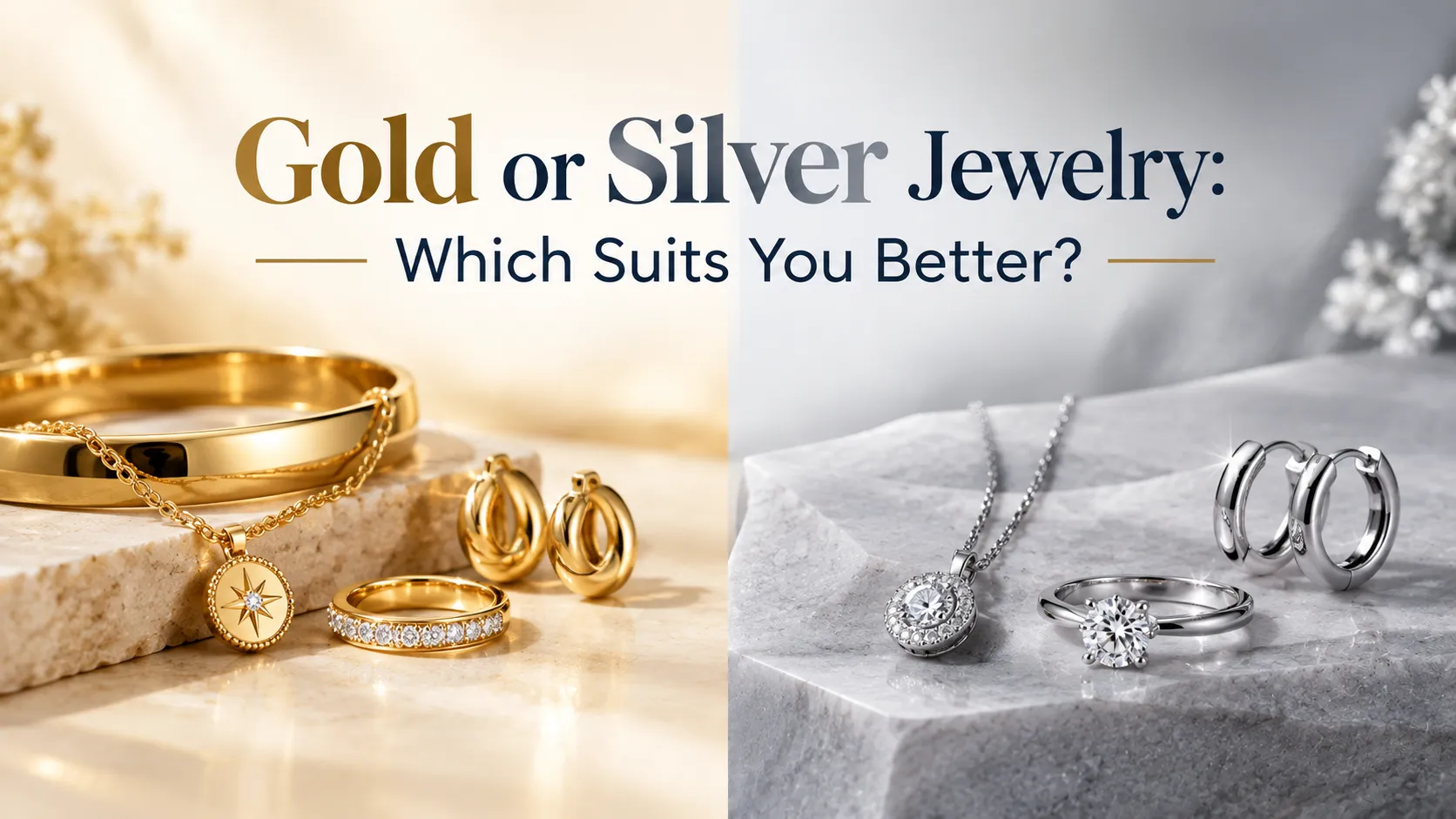
If your skin has cool undertones (your veins look blue or purple), silver, white gold, or platinum will usually look more natural against your skin. If your undertones run warm (veins look greenish), gold tends to flatter more. But undertone is only the first filter — how often you wear the piece, how much upkeep you’re willing to do, and your budget all matter just as much as which one looks better in the mirror.
There’s no universal winner here. There’s a metal that fits your skin, your routine, and your wallet, and figuring out which one that is takes about five minutes.
Key Takeaways
- Undertone is the fastest sorting test. Cool undertones generally lean silver/white metals; warm undertones generally lean gold.
- Gold and silver age differently. Gold resists tarnish; sterling silver needs regular polishing to stay bright.
- Karat purity changes both look and durability. 10k and 14k gold wear better day-to-day than 18k, which is softer but richer in color.
- Silver is the more budget-friendly entry point, but that doesn’t make it lower quality, just a different material with different upkeep.
- Mixing metals is no longer a style mistake. Wearing gold and silver pieces together is standard now, not a faux pas.
The Skin Tone Test: Cool vs Warm Undertones
This is the quickest way to narrow things down, and it takes about ten seconds.
The vein test: Look at the underside of your wrist in natural light.
- Veins that look blue or purple → cool undertone → silver, white gold, or platinum will usually look crisp and clean against your skin.
- Veins that look green → warm undertone → yellow or rose gold will usually look richer and more natural.
- Can’t tell, or they look blue-green → you likely have a neutral undertone, which means both metals work, and the choice comes down to preference rather than skin chemistry.
The hold-up test: If you’re still unsure, hold a gold piece and a silver piece against your skin, one at a time, in daylight. One will usually make your skin look more even and awake; the other can make it look slightly sallow or washed out. That reaction is a more reliable signal than guessing your undertone from scratch.
Neither test is a hard rule. Plenty of people with cool undertones wear gold beautifully, and vice versa — undertone affects how “natural” a metal looks against skin, not whether you’re allowed to wear it.
Gold vs Silver: Durability & Everyday Wear
This is where the real practical differences show up, especially for pieces you plan to wear daily, like an engagement ring or a watch you don’t take off.
| Gold (10k-18k) | Sterling Silver (925) | |
| Tarnish resistance | High: gold doesn’t oxidize | Low: tarnishes with air exposure, needs regular polishing |
| Scratch resistance | Moderate, improves at lower karats | Moderate, softer than gold at the same alloy ratio |
| Everyday durability | Strong, especially 14k | Good, but needs more maintenance to stay looking new |
| Skin reactions | Rare, especially at 14k+ | More common for sensitive skin, since silver alloys often include nickel or copper |
| Typical cost | Higher, tied to gold market price | Lower, more budget-friendly |
Karat purity matters more than people expect. Pure gold (24k) is soft and prone to bending, which is why jewelry is alloyed with other metals. 10k and 14k gold hold up best for rings and daily-wear pieces, since the added alloy increases hardness. 18k gold has a richer, deeper color but scratches more easily, which is why it’s often reserved for pieces that aren’t worn constantly, like earrings or pendants.
White Gold, Platinum & Silver: Don’t Mix These Up
This trips up a lot of shoppers, so it’s worth clearing up directly.
- White gold is yellow gold alloyed with white metals, then coated in rhodium plating to get that bright white finish. The plating wears down over months or years and needs to be reapplied to keep the shine — it’s not a one-time purchase the way it might look at first.
- Platinum is a naturally white metal, denser and more hypoallergenic than white gold, and it doesn’t need replating. It costs significantly more than white gold as a result.
- Sterling silver is a different metal entirely, softer than both, and the most affordable of the three. It’s a great everyday option, but it tarnishes faster and isn’t typically used for stone-set engagement rings meant for decades of daily wear.
If you like the look of white metal but don’t want the plating maintenance, platinum is worth the price difference for a piece you’ll wear every day. If it’s for occasional wear, white gold or even sterling silver can make more sense.
What You’re Actually Paying For
Gold’s higher price tag isn’t just branding — it tracks the live gold market price, plus purity and craftsmanship. Silver’s lower cost reflects its own, much lower market price as a metal. Neither is “the cheap one” or “the premium one” in a way that makes the other lesser — they’re priced according to what they actually are.
This is where it helps to see the cost breakdown rather than guess at it. Custom Karat shows the metal, diamond, and setting cost separately as you build a piece, so you can see exactly what you’re paying for gold purity or a platinum upgrade instead of it being folded into one flat number.
Lifestyle & Occasion Fit
The metal that suits you also depends on how you actually live in your jewelry:
- Hands-on jobs, gym-goers, or anyone rough on their jewelry → 14k gold or platinum hold up better than 18k gold or silver, which show wear faster.
- Jewelry you take on and off often (special-occasion earrings, statement necklaces) → softer, richer 18k gold or sterling silver work fine, since they’re not absorbing daily impact.
- Sensitive skin → 14k+ gold or platinum are generally safer bets than silver alloys, which more often contain nickel.
- Building a everyday stack → mixing gold and silver pieces together is completely normal now. You don’t need to match every piece to one metal anymore.
How to Decide
Run through these four questions before you commit to a metal:
- What does the vein test say? Start with cool vs warm as your baseline, not your final answer.
- How often will you wear it? Daily wear favors gold or platinum; occasional wear opens the door to silver or 18k gold.
- How much upkeep are you willing to do? If polishing isn’t for you, skip silver and rhodium-plated white gold.
- What’s the budget? Silver stretches furthest, gold sits in the middle, and platinum is the premium end.
If you’re still torn between two metals, that’s usually a sign the design matters more than the material. In that case, picking a piece you can customize in either metal, and switching later if your answer changes, is a reasonable way to stop deliberating and just start.
The Bottom Line
There isn’t a “better” metal between gold and silver, only a better fit for your skin, your routine, and how hard you’re on your jewelry day to day. Match the metal to those three things first, and the rest style, design, stone choice gets a lot easier to figure out.
If you already have a metal in mind but haven’t found the right piece, that’s usually a design problem, not a metal one. Custom Karat lets you pick a design already on the site or build your own from scratch, choose the metal and karat that actually fits your lifestyle, and see the price adjust as you go so you’re not stuck choosing between “the ring I like” and “the metal that works for me.”
Frequently Asked Questions
Does gold or silver suit warm skin tones better?
Warm undertones (veins that look greenish on the wrist) generally look more natural next to yellow or rose gold. Cool undertones tend to suit silver, white gold, or platinum better.
Is silver jewelry lower quality than gold?
No, it’s a different metal with different properties, not a lesser version of gold. Sterling silver is more affordable and needs more upkeep to resist tarnish, but it’s not inherently lower quality.
Can you mix gold and silver jewelry?
Yes. Mixing metals is standard styling now, not a mistake. Layered necklaces, stacked rings, and mixed-metal earrings are all common ways to wear both together.
Does white gold tarnish like silver?
Not exactly, but it does dull over time as its rhodium plating wears down, and it needs to be replated periodically to keep its bright white finish. Silver tarnishes from air exposure and needs regular polishing instead.
Which is more affordable, gold or silver?
Silver is generally the more budget-friendly option, since it tracks a much lower metal market price than gold. Gold costs more but resists tarnish and holds up better for long-term daily wear.
Which metal is better for sensitive skin?
Higher-karat gold (14k and above) and platinum are usually safer for sensitive skin, since they contain less of the alloy metals, like nickel, that commonly trigger reactions in sterling silver.
Does gold or silver last longer with daily wear?
Gold, particularly 14k, generally holds up better for daily wear since it resists tarnish and scratching more effectively than sterling silver, which needs more frequent care to stay looking new.

About Author Gautami Teliwadekar
Gautami brings over 10 years of experience in the jewelry industry, with expertise in fine jewelry, custom designs, diamonds, gemstones, and evolving jewelry trends. At Custom Karat, she combines her industry knowledge and passion for craftsmanship to help customers make confident, informed choices when creating jewelry that reflects their unique style.