No products added!

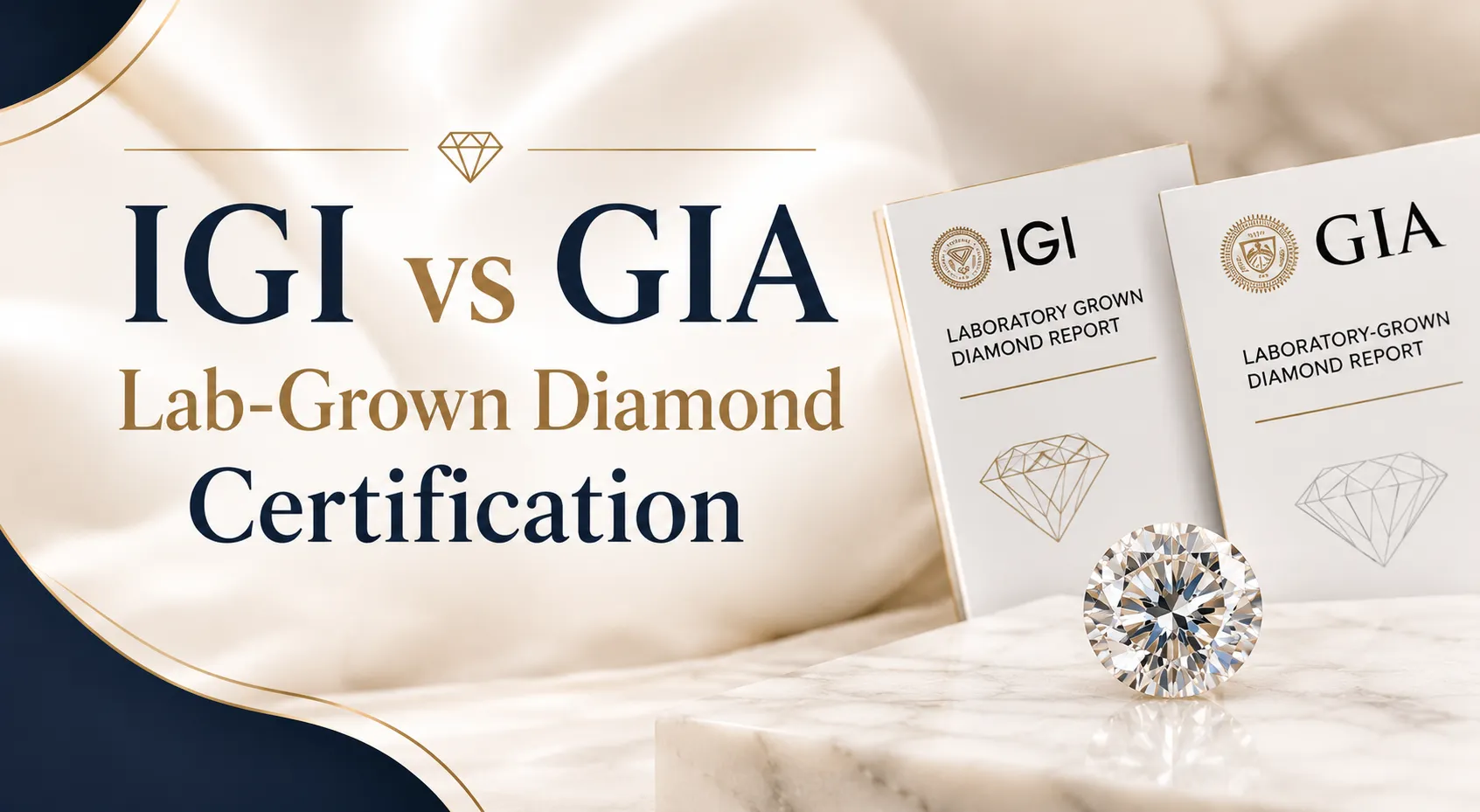
When buying a lab-grown diamond, certification is one of the most important things to check.
A diamond may look beautiful in photos, but a grading report helps verify the details behind that beauty. It can confirm whether the diamond is lab-grown, its carat weight, measurements, cut quality, color, clarity, and other important quality factors.
Two of the most recognized names in diamond certification are IGI and GIA.
Both are respected gemological laboratories, but they present lab-grown diamond information differently. For buyers, this often creates confusion: Is IGI better for lab-grown diamonds? Is GIA more trusted? Which certificate should you choose before buying a lab-grown engagement ring or custom diamond jewelry?
This guide explains the difference between IGI and GIA lab-grown diamond certification and helps buyers understand which report is more useful for their purchase.
Key Takeaways
- IGI and GIA are both recognized names in diamond grading and identification.
- IGI lab-grown diamond reports commonly provide detailed 4C-based information.
- GIA is globally respected and developed the modern 4C diamond grading system.
- GIA currently classifies many colorless to near-colorless lab-grown diamonds as Premium or Standard through its Laboratory-Grown Diamond Quality Assessment.
- IGI reports are often easier for buyers who want to compare lab-grown diamonds using cut, color, clarity, and carat.
- GIA reports carry strong authority, but buyers should understand how its lab-grown diamond assessment format works.
- Certification is important, but it does not replace craftsmanship, metal quality, setting strength, or CAD approval.
- The best certificate is the one that gives clear, verifiable information for the diamond being purchased.
What Is Lab-Grown Diamond Certification?
Lab-grown diamond certification is a professional report issued by a gemological laboratory.
The report helps describe and identify the diamond so buyers can understand what they are purchasing.
A lab-grown diamond report may include:
- Diamond origin
- Shape and cutting style
- Measurements
- Carat weight
- Color information
- Clarity information
- Cut grade or quality assessment
- Polish
- Symmetry
- Fluorescence
- Growth method
- Treatment details
- Laser inscription
- Report number
Certification is especially important when buying diamonds online because buyers cannot physically inspect the diamond before ordering.
Why Certification Matters for Lab-Grown Diamonds
Certification matters because lab-grown diamonds must be clearly identified and properly described.
Lab-grown diamonds are real diamonds, but they are not mined diamonds. They are created in controlled laboratory environments. The FTC also advises sellers to clearly disclose laboratory-created diamonds so consumers understand they are not mined diamonds.
A certificate helps buyers confirm:
- The diamond is lab-grown
- The diamond is not a simulant
- The carat weight is documented
- The quality details are recorded
- The report number can be verified
- The diamond can be matched to its report
- The seller is being transparent
Without certification, buyers have to rely only on the seller’s product description.
What Is IGI Certification?
IGI stands for the International Gemological Institute.
IGI provides diamond reports that identify whether a diamond is natural or lab-grown and document the diamond’s 4Cs: cut, color, clarity, and carat weight.
An IGI lab-grown diamond report commonly includes:
- Lab-grown origin
- Shape and cutting style
- Measurements
- Carat weight
- Color grade
- Clarity grade
- Cut grade
- Polish
- Symmetry
- Fluorescence
- Laser inscription
- Report number
IGI certification is useful for buyers because it presents diamond details in a familiar format.
For example, if a buyer is comparing two lab-grown diamonds online, an IGI report makes it easier to compare carat weight, color, clarity, cut, and measurements side by side.
What Is GIA Certification?
GIA stands for the Gemological Institute of America.
GIA is one of the most respected names in the diamond industry and is known for developing the modern 4C system used to describe diamond quality.
For lab-grown diamonds, GIA has changed how it presents quality information. GIA’s Laboratory-Grown Diamond Quality Assessment currently classifies loose, colorless to near-colorless lab-grown diamonds of 0.15 carats or more as Premium or Standard. GIA also laser inscribes the diamond girdle with “Laboratory-Grown” and the GIA quality assessment number.
This makes GIA highly trusted, but its lab-grown diamond assessment format may feel different from traditional 4C reports.
For buyers who want detailed cut, color, clarity, and carat comparisons, IGI may feel more direct. For buyers who value GIA’s authority and simplified quality assessment, GIA can still be a strong option.
IGI vs GIA Lab-Grown Diamond Certification: Main Difference
The main difference is how each lab presents lab-grown diamond quality.
IGI commonly provides detailed 4C-based lab-grown diamond reports. GIA currently uses a distinct Laboratory-Grown Diamond Quality Assessment for many qualifying lab-grown diamonds, classifying them as Premium or Standard.
| Factor | IGI Certification | GIA Certification |
| Full Form | International Gemological Institute | Gemological Institute of America |
| Report Style | Detailed 4C-based report | Premium or Standard quality assessment for many lab-grown diamonds |
| Best For | Buyers comparing cut, color, clarity, and carat | Buyers who value GIA authority and simplified assessment |
| Lab-Grown Identification | Clearly identifies lab-grown origin | Clearly identifies laboratory-grown origin |
| Color and Clarity | Usually shown as specific grades | May be included in broader quality assessment format |
| Buyer Comparison | Easier for side-by-side online comparison | More simplified, but may need explanation |
| Laser Inscription | Commonly available | Girdle inscription includes “Laboratory-Grown” and GIA assessment number |
| Trust Level | Widely used and trusted | Globally recognized and highly respected |
IGI vs GIA: Which Is Better for Lab-Grown Diamonds?
There is no single answer for every buyer.
For many lab-grown diamond shoppers, IGI is more practical because its reports commonly provide detailed 4C information. This makes it easier to compare diamonds online before choosing one for an engagement ring, pendant, bracelet, earrings, or custom jewelry.
GIA is also highly trusted, but buyers should understand its lab-grown diamond assessment format. Instead of traditional natural diamond color and clarity nomenclature for many lab-grown diamonds, GIA uses broader descriptive categories such as Premium and Standard.
A simple way to understand it:
- Choose IGI if you want detailed 4C grading and easier online comparison.
- Choose GIA if you value GIA’s global authority and are comfortable with its lab-grown diamond assessment format.
- Choose either only when the report is verifiable and matches the diamond being sold.
Is IGI Trusted for Lab-Grown Diamonds?
Yes, IGI is trusted for lab-grown diamond certification.
IGI reports identify whether a diamond is natural or lab-grown and document the diamond’s 4C characteristics. This makes IGI useful for buyers who want to compare lab-grown diamonds based on measurable quality details.
IGI certification is especially helpful when buying:
- Lab-grown engagement rings
- Custom diamond rings
- Diamond pendants
- Diamond earrings
- Tennis bracelets
- Diamond necklaces
- Men’s diamond jewelry
- Bridal jewelry
Before buying, buyers should verify the report number and confirm that the diamond details match the certificate.
Is GIA Trusted for Lab-Grown Diamonds?
Yes, GIA is highly trusted in the diamond industry.
GIA has strong global recognition and a long history in diamond grading. Its 4C system is one of the most widely recognized frameworks for describing diamond quality.
For lab-grown diamonds, buyers should understand that GIA’s current assessment format is different from a traditional natural diamond grading report. GIA’s Laboratory-Grown Diamond Quality Assessment classifies qualifying lab-grown diamonds as Premium or Standard and includes laser inscription details.
This does not make GIA less trustworthy. It simply means buyers should understand what the GIA report is telling them before comparing it with an IGI report.
Which Certificate Is Easier for Buyers to Understand?
For many online shoppers, IGI is easier to understand because it uses detailed grading information that buyers commonly expect.
A buyer can compare:
- One diamond’s color grade with another
- One diamond’s clarity grade with another
- Carat weight differences
- Cut grade differences
- Measurements and proportions
- Polish and symmetry
GIA’s lab-grown diamond assessment is simpler in one way because it gives an overall quality classification. However, buyers who want detailed grade-by-grade comparison may need more explanation.
For SEO and buyer education, this difference matters because many shoppers search for terms like:
- IGI certified lab-grown diamond
- GIA certified lab-grown diamond
- IGI vs GIA lab diamond
- Best lab-grown diamond certification
- Is IGI good for lab-grown diamonds?
- Is GIA better than IGI?
What Should Buyers Check on an IGI or GIA Report?
Before buying a lab-grown diamond, buyers should review the report carefully.
Diamond Origin
The report should clearly state that the diamond is lab-grown. This avoids confusion between mined diamonds, lab-grown diamonds, and simulants.
Report Number
Every certified diamond should have a report number. Buyers should verify this number through the laboratory’s official report verification tool.
Carat Weight
Carat weight tells buyers how much the diamond weighs. For finished jewelry, buyers should also check whether the listed weight is for one diamond or total carat weight.
Color or Quality Information
IGI commonly provides color grades.
GIA’s lab-grown assessment may use broader Premium or Standard quality categories for qualifying stones.
Clarity or Quality Information
IGI commonly provides clarity grades.
GIA’s lab-grown assessment evaluates overall quality differently, so buyers should understand what the report format means.
Cut and Measurements
Cut and measurements affect how the diamond looks. Two diamonds with the same carat weight can appear different depending on proportions.
Polish and Symmetry
Polish and symmetry show the quality of finishing and alignment. These details can affect the diamond’s visual performance.
Laser Inscription
A laser inscription helps match the physical diamond to the report. This is an important trust signal when buying certified diamonds online.
IGI vs GIA for Lab-Grown Engagement Rings
For lab-grown engagement rings, certification is especially important because the center stone is usually the main value driver.
IGI certification is useful because buyers can compare detailed 4C information before choosing a center diamond.
GIA certification is also valuable for buyers who prefer GIA’s brand authority and are comfortable with its lab-grown diamond quality assessment format.
For engagement rings, buyers should check:
- Diamond origin
- Report number
- Carat weight
- Diamond shape
- Cut quality
- Color or quality category
- Clarity or quality category
- Measurements
- Laser inscription
- Ring setting
- Metal quality
- CAD approval
- Craftsmanship
IGI vs GIA for Custom Diamond Jewelry
For custom jewelry, certification helps buyers choose the diamond before production begins.
This is important because the diamond affects the final design, price, and overall appearance of the jewelry.
Certification is useful for:
- Custom rings
- Diamond pendants
- Diamond necklaces
- Tennis bracelets
- Diamond earrings
- Men’s jewelry
- Bridal jewelry
- Hip hop jewelry
For example, a solitaire ring may need a higher-quality center stone, while a tennis bracelet may need consistency across many smaller diamonds. Earrings should be matched carefully, and pendants should balance diamond size with design and wearability.
Certification Does Not Replace Craftsmanship
A certificate tells you about the diamond. It does not guarantee the finished jewelry is well made.
Even a certified diamond can look disappointing if it is placed in a weak setting or poorly finished design.
Before buying certified lab-grown diamond jewelry, buyers should also check:
- Metal type
- Metal weight
- Setting style
- Stone security
- CAD design
- Ring size or jewelry fit
- Clasp or backing quality
- Polishing
- Comfort
- Craftsmanship
- Shipping process
This is especially important for engagement rings, bracelets, earrings, and jewelry worn daily.
Common Mistakes Buyers Make
Thinking GIA Is Always Better for Every Lab-Grown Diamond
GIA has strong authority, but its lab-grown diamond format may not always offer the detailed 4C comparison some buyers expect.
For lab-grown diamond shopping, IGI can often be easier to compare because of its detailed report style.
Ignoring the Report Number
A certificate should always be verified. Buyers should match the report number, carat weight, measurements, and inscription details before purchase.
Looking Only at Certification
Certification is important, but it is not the full story. The finished jewelry quality also depends on metal, setting, CAD design, craftsmanship, and finishing.
Confusing Lab-Grown Diamonds With Simulants
Lab-grown diamonds are real diamonds, but they are not mined diamonds. They are different from simulants such as cubic zirconia or moissanite.
Choosing Based Only on Carat
A bigger diamond is not always better. Cut quality, proportions, clarity, and overall design affect how beautiful the diamond looks.
Which Certificate Should You Choose?
Choose IGI if:
- You want detailed 4C grading.
- You want to compare multiple lab-grown diamonds online.
- You want clear cut, color, clarity, and carat information.
- You are buying a lab-grown engagement ring or custom jewelry piece.
- You want an easy-to-read report format.
Choose GIA if:
- You prefer GIA’s global authority.
- You are comfortable with its Premium or Standard quality assessment format.
- You want confirmation from a highly respected gemological laboratory.
- The seller clearly explains what the GIA assessment means.
- The report details match the diamond being sold.
The best certificate is the one that gives clear, accurate, and verifiable information for the diamond you are buying.
Buyer Checklist Before Choosing IGI or GIA Certified Lab-Grown Diamonds
Before purchasing, check:
- Is the diamond clearly disclosed as lab-grown?
- Is the report number available?
- Can the report be verified online?
- Does the report match the diamond details?
- Are the diamond’s carat weight and measurements clear?
- Is color or quality information clearly explained?
- Is clarity or quality information clearly explained?
- Is there a laser inscription?
- Does the diamond look eye-clean?
- Is the cut quality strong?
- Is the price aligned with the quality?
- Is the jewelry setting well made?
- Is CAD approval available for custom designs?
This checklist helps buyers make a more confident decision before ordering.
Why Choose Custom Karat for Certified Lab-Grown Diamond Jewelry?
Custom Karat helps buyers create custom diamond jewelry with transparency, design control, and expert craftsmanship.
With Custom Karat, buyers can choose lab-grown or natural diamonds based on quality, budget, and design preference.
Custom Karat offers:
Certified Lab-Grown Diamond Options
Buyers can choose diamonds with clear grading or quality details. This helps them understand the diamond before production begins.
IGI and GIA Guidance
Custom Karat helps buyers understand what different diamond reports mean. This makes it easier to compare stones and choose the right option for the design.
Custom Jewelry Design
Buyers can create engagement rings, pendants, necklaces, bracelets, earrings, men’s jewelry, bridal jewelry, and hip hop jewelry. Each piece can be designed around personal style, size, budget, and occasion.
CAD Design Previews
CAD previews help buyers review the design before production. This helps confirm stone placement, proportions, setting style, and overall appearance.
Premium Metal Choices
Buyers can choose from gold, white gold, rose gold, platinum, sterling silver, gold vermeil, or suitable custom finishes. The right metal improves durability, comfort, and long-term wear.
Transparent Pricing
Pricing is based on diamond quality, metal, craftsmanship, design complexity, and finishing. This helps buyers understand where their budget is going.
Direct Manufacturer Value
Custom Karat offers direct manufacturer craftsmanship. This helps reduce traditional retail markups while keeping the focus on quality and customization.
Expert Craftsmanship
Each piece is made with attention to stone setting, polish, durability, comfort, and long-term wearability. A certified diamond still needs expert craftsmanship to become beautiful finished jewelry.
Secure USA Shipping
Finished jewelry is securely packed and shipped to customers in the USA. This gives buyers more confidence when ordering custom jewelry online.
Final Verdict
IGI and GIA are both respected names in diamond certification, but they are different in how they present lab-grown diamond quality.
IGI is often more practical for lab-grown diamond buyers who want detailed 4C information and easy online comparison.
GIA carries strong global authority, but buyers should understand that its current lab-grown diamond quality assessment may classify qualifying stones as Premium or Standard instead of presenting the same traditional grading format used for natural diamonds.
For most buyers, the best certificate is the one that is clear, verifiable, and useful for comparing diamond quality.
When buying lab-grown diamond jewelry, do not stop at certification. Review the diamond, setting, metal, CAD design, craftsmanship, and finished jewelry quality.
Custom Karat helps buyers create certified lab-grown diamond jewelry with premium materials, CAD approval, transparent pricing, expert craftsmanship, and direct manufacturer value.
FAQs
Is IGI good for lab-grown diamonds?
Yes. IGI is trusted for lab-grown diamond certification and commonly provides detailed 4C-based reports.
Is GIA good for lab-grown diamonds?
Yes. GIA is highly respected, but buyers should understand its current lab-grown diamond quality assessment format.
Which is better for lab-grown diamonds, IGI or GIA?
IGI is often easier for detailed lab-grown diamond comparison. GIA is also trusted but presents lab-grown diamond quality differently.
Does IGI grade lab-grown diamonds?
Yes. IGI provides reports that identify lab-grown origin and document important 4C details.
Does GIA grade lab-grown diamonds?
GIA evaluates lab-grown diamonds through its Laboratory-Grown Diamond Quality Assessment and classifies qualifying stones as Premium or Standard.
Are IGI certified lab-grown diamonds real diamonds?
Yes. IGI certified lab-grown diamonds are real diamonds created in controlled laboratory environments.
Should I buy a lab-grown diamond without certification?
For engagement rings and high-value custom jewelry, it is better to choose a certified or properly assessed lab-grown diamond.
Can I verify IGI or GIA reports online?
Yes. Buyers should verify the report number through the laboratory’s official verification tool.
Does certification guarantee sparkle?
No. Certification provides diamond details, but sparkle depends strongly on cut quality, proportions, and craftsmanship.
Does certification guarantee jewelry quality?
No. Certification grades or assesses the diamond. The finished jewelry also depends on metal quality, setting, CAD design, and craftsmanship.

About Author Brijesh Sharma
Brijesh Sharma is a jewelry retail industry author who shares expert insights on diamonds, lab-grown jewelry, custom designs, and smart jewelry buying. His content helps customers understand quality, pricing, trends, and craftsmanship so they can make confident jewelry purchase decisions.